Deep in the Heart of Texas

We were beginning to enjoy the cool fall weather. And then it hit. In Southern California, we call it the Santa Anas. You might know it as Indian Summer. Put simply, it got @#$%ing hot!!! 110 in the shade.

Life hands you lemons, you make lemonade. The perfect opportunity for a last barbecue or two. So the other night, we called some friends over and did Texas-style. Stood out on the deck with my tongs like a cowboy. Hollered at the chickens and the kids, spit into a tin. Perhaps it’s still warm where you are, and you’ll want to try it too. Put on some Patsy Cline and call the cowboys in…

More knowledgeable people than I could speak more articulately on the regional differences in barbecue. In Texas, I know they love their beef, and they like chilies. I know you’ll love this steak with salty-sweet chili rub. To go with it, I made cheese grits and an iceberg wedge salad with bleu cheese dressing and pancetta — neither strictly Texan, but pretty good foils to the flavorful steak. We drank one of our big jammy family zinfandels — there’s no better varietal with barbecue. Of course, beer, a nice mint julep or even a zesty margarita would’ve paired well. This Texas dinner will serve 4, amply.

*   *   *

Cowboy-Style Grilled Steak

2 lbs good steak on the bone (rib-eye, preferably; but porterhouse is good too)
2 tbsp salt
1 tbsp sugar
2 tbsp pimenton (Spanish smoked sweet paprika) or regular paprika
1 tsp ground chipotle pepper
1 tsp ground pasilla or other mild red chili

Take steaks out of the fridge about one hour before you grill. In the meantime, combine other ingredients to make a rub. About 10 minutes before grilling, sprinkle steaks evenly with rub. Gently massage the rub into the meat.

Heat your BBQ as high as it will go — mine gets up around 600 degrees. Cook your steaks 3 or 4 minutes on each side, depending on thickness, until cook medium or medium rare to your preference. Remove, cover with foil, and let sit for 10 minutes. Then use a very sharp knife to cut across the grain into 1/2 inch thick slices. Spread a few slices on each person’s plate, and serve with cheese grits.

Cheese Grits
(Note: I highly recommend buying some Anson Mills grits from the link on this blog. They’re about the best grits on earth. While you’re there, pick up some dried polenta, including the fabulous rustic polenta integrale. Make your shipping costs worthwhile!)

1 cup dried grits
water
1/2 cup grated cheddar
1/4 cup grated pecorino romano or asagio
1 tbsp butter
salt & pepper to taste

Heat about 2 cups of water in a pot to a simmering boil, and add dried grits. Reduce heat to medium low and cook, stirring and adding more water frequently, for up to an hour. Grits should be tender and not at all crunchy. Add salt and pepper to taste, then stir in cheeses. Stir in butter last, and then cover and let sit for five minutes. Scoop some onto each of four plates, and surround with a fan of the steak slices.

Iceberg Wedge Salad

1 head iceberg lettuce
1/2 cup crumbled bleu cheese (roquefort, gorgonzola, etc.)
1/4 cup milk
1 tbsp mayonnaise
4 strips pancetta (or bacon), cooked to crisp
salt & pepper

Remove the core from the lettuce, and cut into quarter wedges. Mix the bleu cheese, milk and mayo vigorously together until it forms a thick dressing (some chunks of bleu cheese should remain). Drizzle some dressing over each of the wedges, then drizzle with a little olive oil. Sprinkle with salt and pepper to taste, and lay a cooked strip of pancetta on top of each. Serve.


The Boy & the Fig

People, I find, either love figs or hate them. Mostly it’s less about the food than the tree. If you love figs and you have a fig tree, you are thrilled every late summer when the branches are nearly exploding with ripe fruit. If you hate figs, you despair as the ground of your garden or driveway are littered with gooey, sticky, fly-covered fruit. Others have fig trees and are merely agnostic about them. “Oh, yeah… it’s a nice tree. But we never eat the figs. No idea what to do with them.”

Eat them, my friends, eat them.

My friends with fig trees are never surprised when they invite us over in the late summer and find me clinging simian-like amidst the high branches of a tree or scaling a wall. Some of them look at me skeptically and ask what on earth I’m going to do with the fruits — fig haters, they. Here’s what I teach them:

There’s something sexy and carnal about figs. The way they hang ripely. The way they burst open and reveal their ruby insides. Even the leaves bring to mind Renaissance paintings of Adam & Eve in the garden, body parts barely covered by fig leaves, succumbing to the allure of temptation. But I digress…

I dreamed of having my own fig tree. Last week, we had a surveyor out. We’d always thought our property extended beyond the fence but weren’t sure. I was walking the additional half acre or so we’d picked up in the process with him, and he pointed to a tree. “Well, that’s a strange looking tree!” I looked over, and there hidden among the oaks, a beautiful tall fig tree, reaching its limbs to clear the canopy. Right on the far corner of my own property! So maybe next summer, if you’re lucky, you won’t find me lurking in your yard and scaling your wall…

Teach Your Children Well

This is a post for parents. And for those who are childlike at heart. Because it is in approaching food with a childlike joy and wonder that your cooking will be transformed. And your eating.

Of course, any parent will tell you that children don’t always approach food with a childlike joy. When my son, Flynn, was young. I used to make him baby risottos. They were so good and he loved them so much that we thought of starting a baby food company. But then something happened. He switched. He was suspicious of everything I made. “Dad, there’s a dot in my food!” he would squeal in terror, and the simplest dishes would be derailed by a speck of pepper or a stray trace of parsley.

I was crestfallen.

A chef. And my first-born son would eat nothing but chicken nuggets.

The question, of course, was how to ever get him eating interesting food again. The answer was simple, if not exactly quick. Introduce him to the joy of growing, shopping, cooking and eating. And get him involved. Are your kids involved? Are YOU involved??

I expanded the garden, and gave Flynn his own tomato and corn plants. I got chickens, and put him in charge of egg collection (he now has an egg business selling them in the neighborhood — need any really GOOD eggs? Call Flynn…) My sister got him his own cookbook for his birthday — what a gift! Sometimes I find him sitting on the couch on a Saturday afternoon reading his cookbook. Sometimes he and I watch the cooking shows on PBS on Saturday afternoon. Sometimes we make what we’ve seen.

And I began to request his help in the kitchen. I would let him chop things — supervised, of course — with my really cool, sharp chef’s knife. (Chef’s knives are enticingly exciting to kids, especially boys.) I let him stir sauces. I let him toss the pizza dough in the air. And anytime he wanted a bite of something, I gave it to him.

While he’s still not eating EVERYTHING, there are few things he won’t try. And he’s had the experience enough times of enjoying something wonderful he didn’t want to try, that he believes me when I say, “No, seriously… you’re gonna LOVE this!” Plus, he learned to love the experience of sourcing our food. We go on food adventures. To Little Tokyo to get imagawayaki hot off the grill. To the cheese shop in Beverly Hills. To East L.A. to get handmade tortillas.

Flynn wants to go to France to try the stinky cheeses there. I heard him telling a friend in his taekwondo class the other day about the shabu shabu we were having for dinner that evening. “No,” he explained, his hands gesticulating animatedly, “you cook it right on the table!”

Have you made food an adventure for your children? First, of course, you must make it an adventure for yourself. I guess that’s really what this blog is all about. We’re all kids at heart. Life should always be approached with bright-eyed wonder, as an adventure. And in life, food is one of the greatest adventures of all.

Rome’s Best Soup

I was about 11 when it happened.

Spending the summer in Europe with my family, I was gazing out the window of a restaurant high above Florence in the Etruscan town of Fiesole (where Gertrude Stein and Alice B. Toklas used to spend their summers entertaining Picasso and other friends, of which Stein wrote, “The days were long and the nights were long and the life was good.”). The waiter brought a soup that was one of many illuminating moments on that trip which would change my life. It was called stracciatella, “little rags” in Italian. It was a specialty of Roma, we were told. I’d never tasted soup like it.

Keep in mind this was the late 1970s, a time when “Italian” in the U.S. — even in sophisticated Southern California — meant Papa Tony’s, greasy meatballs in tomato sauce, pizza and overblown Jersey-style minestrone. Here was a soup that was the antithesis of everything I’d known to be Italian.

It was also miraculously simple. A clear, resonant golden broth in which floated those little rags — shreds of egg and spinach flavored with parmesan, nutmeg and pepper. A soup that would come to illustrate perfectly my core cooking belief in highlighting simple, fresh flavors that sing like a symphony together. Beautiful to see, and memorable to taste. Make this soup — I can make no promises but it may change your life too. Especially if done properly.

As I often say on this blog in regard to the simplest recipes, success depends entirely on the quality of your ingredients. This is a soup, for example, that benefits highly from a good homemade stock. Fresh farmer’s market spinach, the best parmesan reggiano you can find, and really good eggs don’t hurt either. And there may be no experience in the kitchen as immediately gratifying as grating a pod of nutmeg directly into your food.

Stracciatella

1 quart homemade chicken stock
3 eggs
1 cup finely chopped spinach
1 tbsp semolina flour (optional)
1/4 cup parmesan reggiano
a few grates fresh nutmeg

If you don’t have chicken stock, get yourself a whole chicken. Throw it in a pot with an onion, a bay leaf, a carrot and about a gallon of water. Bring to a boil, skim off froth, turn down to a simmer and cook for about 30 minutes. Add salt to taste (you’ll need a good bit of salt here). Remove the chicken (use the meat for sandwiches or tacos). You can continue reducing the broth over medium heat for another hour if you want a stronger broth. (I would recommend doing this.) Strain through a fine sieve into another pot. Let cool. At this point, take out your quart for your soup and freeze any remaining stock in freezer back for future use. (I always keep three or four bags of chicken stock in the freezer.)

Heat your stock over medium to a simmer. Beat the eggs in a large bowl, add the spinach and the semolina and stir together. Add the parmesan, grate a little nutmeg over the top (or throw in a pinch of pre-grated nutmeg), combine thoroughly. Turn off the stock, slowly pour in the egg/spinach mixture, and cover. Let sit for five minutes. Then, gently break up to “rags” in your soup with the back side of a ladle. Serve.

The Most Expensive Ham in the World

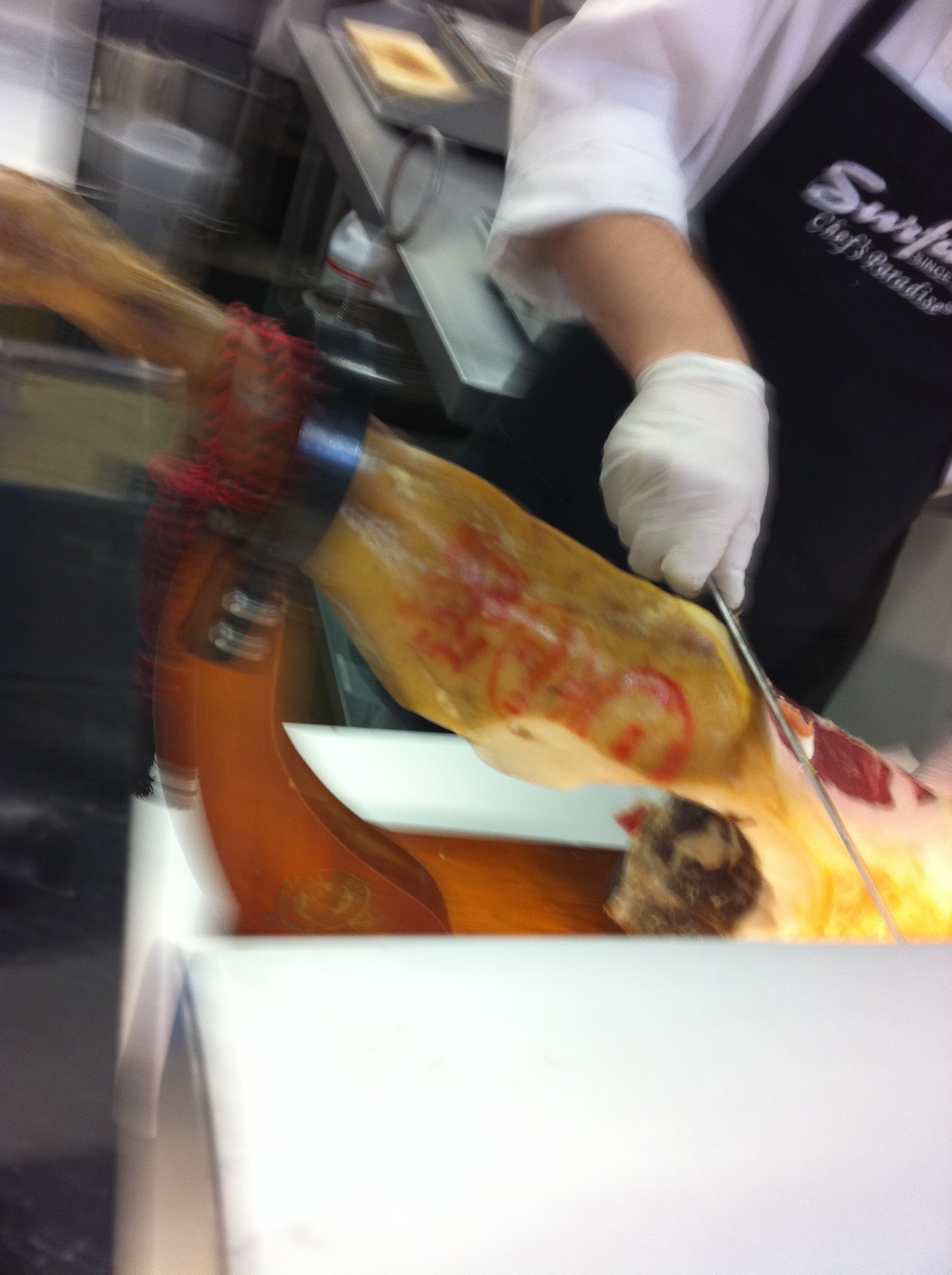
jamón iberico bellota

I’d been reading about the stuff for years. A mythical ham cured for years from the meat of the black-hooved Iberian pig, left alone to wander among the oak woods of Salamanca foraging for acorns — “bellotas” in Spanish.

If you’ve ever been to Spain, you know they’re serious about their ham. One of the most popular restaurants in Madrid is the Museo de Jamón — the “Ham Museum”. And in a country that takes its ham this seriously, iberico bellota is king. For years if you wanted some, you would have to travel to Spain. Only recently was it cleared for export to the United States, with our stringent regulations against the importing of long-fermented, unpasteurized things.

Guy carving iberico bellota

Iberico bellota is one of the best things I’ve ever put in my mouth. It will make you forget that proscuitto de Parma you used to think was so good. I love to watch the guy carving slices from the whole ham in the traditional manner (it is never sliced on a machine like proscuitto, so it always has a rustic, thicker quality). The meat explodes on your tongue in layers of flavor — nutty and dense, elegant and briny — and the fat is unctuous and silky. I must stop talking about it now or I’m going to have to excuse myself…

It is, indeed, the most expensive ham in the world — I pay $135 a pound for it, and am grateful for the privilege. I don’t buy it often, and usually get a quarter pound for $35. It’s plenty. You might have trouble finding this stuff. If I were you, I would make like a detective and do whatever you had to do to pick up its trail. If you live in L.A., I get mine at Surfa’s in Culver City. You could likely get it at the Spanish Table in Seattle (I know there’s a few of you out there). Probably Dean & DeLuca’s or someplace like that in NYC. You could buy a whole one online from tienda.com for $1,400. (Let me know… I might go in on it with you.)

A recipe?

Buy some iberico bellota. And eat it. Serves 1. (You won’t want to share.)

If you have to do something to it, get the best crusty loaf of bread you can buy, get the best butter you can buy… tear off a piece, spread a little butter, top with iberico bellota, and sprinkle with a little Maldon salt.

In heaven, iberico bellota will grow on trees like figs.

Previous Older Entries