I Believe in the Bean

If you’ve read much of this blog, you know that I’m a big fan of beans.

I like all kinds of beans — soupy black beans with garlicky, citrussy Cuban food (that’s the next post, so stay tuned), earthy borlotti beans from Italy (see two posts back), big meaty faba Asturiana beans from Spain, delicate and floral flageolets from France, fermented Chinese black beans, edamame, Mexican pinto beans…

Today I’m writing — or actually talking — about cannellini beans. In the following video, I’ve cooked a pot of these versatile beans, and prepared them four different ways… so you get an idea of how easy they are to make, and how many different things you can do with them. Of these four preparations, I’ve created two in an Italian style, one Spanish and one French. All take no more than a few minutes to make, once you’ve actually cooked the beans. You can even cook a big batch of beans and keep them in the fridge for a week or so, and make different bean dishes on different nights. Enjoy!

Good Gadget, Bad Gadget, Pt. II

There’s a whole industry based on creating useless gadgets. I may have to get creative and come up with something myself. Get a piece of that business. Seems people actually buy these things.

I was embarrassed to discover some bad gadgets in my own kitchen drawers… must’ve been gifts.

A little brush to brush... uh, something off?

More

Me & Mr. Bean

“When young professionals and the socially hip raise chickens in their backyards, newspapers do articles with slideshows. When us Mexicans do it? People call code enforcement.” — Gustavo Arellano

So it must be for the resourceful peasants of Italy when they see their leftover bean soups appearing on the menus of fashionable trattoria in New York and Los Angeles. Something born of necessity and created from leftovers in Tuscany became something craved by starlets after their yoga class in Santa Monica.

Ask a hundred Italians how to make it, and you’ll get a hundred different recipes. And they’ll all be equally good. I’ve had countless variations of this soup in Italy, and in the states. I’ve made countless variations — some with bread, some with carrots and meatballs, meatless variations for vegetarians, and so on. Here’s a simple recipe that’s sure to please your guests. If you don’t eat meat or if you’re having yoga students over, leave out the pancetta. It won’t be quite as good. But that’s the burden you’ll have to carry…

*  *  *

Sopa de Fagioli
Serves 4 -6

1 quart chicken stock
1 cup borlotti beans (or cannellini or red kidney beans)
A few slices of pancetta or bacon, chopped up
1 onion
1 cup roughly chopped cavolo nero (Tuscan kale)
1 sprig rosemary
1/2 cup small pasta (orrechiete, macaroni, etc.)
1/4 cup olive oil, plus extra for drizzling
salt & pepper to taste

Soak the borlotti beans over night. Then cook covered in water over medium heat for about an hour to an hour and a half, or until tender (add more water if needed). Simmer until most of the water is gone, and turn off heat.

Cook the pancetta in half the olive oil (1/8 cup) in a small pan over medium heat until it is well cooked, but not crisp. Add chopped onion and rosemary and cook for a couple minutes until onion is golden. Remove rosemary. Add onion/pancetta mixture to the chicken stock, along with the kale and the beans. Add remainder of olive oil, and bring to a simmer over medium heat. Add dried pasta, cover, and cook over medium low for about 30 minutes, stirring occasionally. Season with salt to taste.

To plate, ladle a good scoop or two of the soup into a bowl, drizzle with more olive oil and top with a twist of freshly ground black pepper. You could also add a sprinkle of crushed red pepper to give it a little heat, or sprinkle some parmesan over the top for an additional layer of flavor. Enjoy!

And here’s a fun kids outtake:

Gutsy Eaters Only

Here’s a fun little quiz.

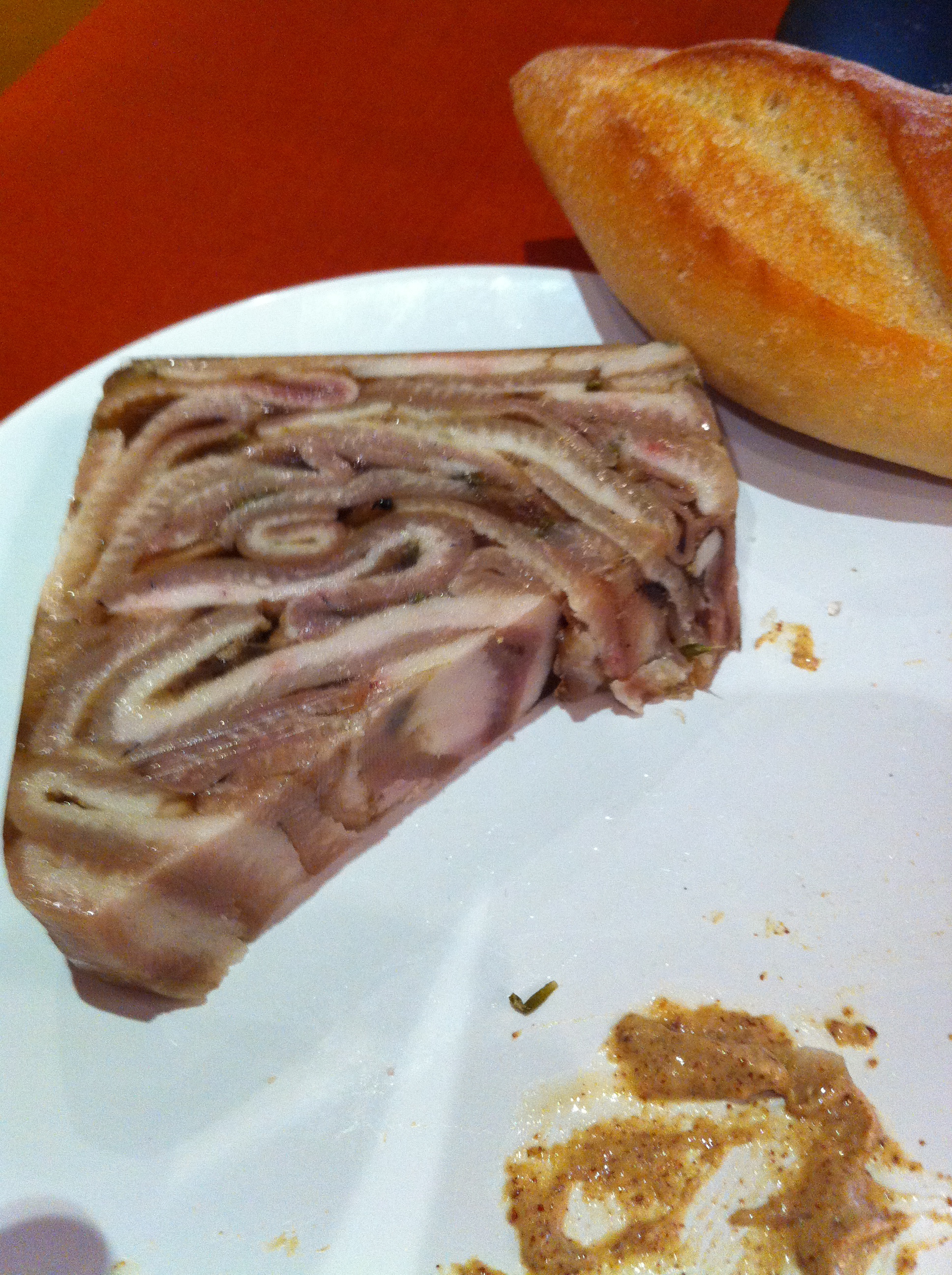
What is it???

The answer is none of the above. Actually, the answer is “I don’t know,” even though I ate some of it.

I don’t typically eat things I don’t know what they are. But my friend got this in his “Salumi Society” monthly shipment from Boccalone in San Francisco (see “Links”), which led us to the conclusion that it was some sort of cured pork product and that we were meant to eat it. We poked at it first, trying to figure out what exactly it was. Some sort of offal, obviously — perhaps a stomach lining? We tried it on bread. I’d give it a “3” on the Curious Meatometer 1-5 rating scale. It was not bad, nor was it delicious. The literature that came with it suggested it was very good with beans. So I took some home, cooked it with cannellini beans, and we tried it again. The beans were very good, although they were good before I added the pork thing. It contributed a certain porkiness to the meal, and the boingy toothsomeness of innards was interesting. But I certainly wouldn’t spend a lot of money on it.

Not that you should spend a lot of money on it. It’s the part most people throw away.

I struggle with offal. Even the word is so close to “awful.” I like it theory — it’s admirable if you’re going to kill an animal, to eat the entire animal, the way they do in so many countries and cultures. In America, we like it if they do whatever they can before we eat it to make it seem NOT like an animal. We like to buy our steaks and chicken breasts prettied up and sold in styrofoam — sort of like they were simply fruits picked off the animal. I couldn’t even kill and cook the roosters two of our baby chicks turned into, although my Guatemalan housekeeper’s eyes lit up carnivorously at the suggestion that she might take them.

It’s more the reality of it that I have trouble with. Like, the part about having it in your mouth. It tastes organny to me. On the advice of friends, I’ve tried menudo when I’ve had hangovers a few times, and generally gagged. I do like sweetbreads, although as innards go they’re fairly dainty.

I will keep trying them. I consider it my duty as a carnivore. As Mario Batali said, “It has always surprised me that some people are suspicious of offal and yet have no fear of eating an arm, a shoulder or the fatty muscle under the rib cage (i.e. the steak).”

Next Newer Entries