Building a Better Burger

Each year, as summer fades to fall, I reflect upon a season of dreadful hamburgers I’ve been served at parties and barbecues over the previous three months.

It’s not that hard to make a great hamburger. So why do so many people screw them up. Several reasons, the top two of which are:

• Too long on the grill/overcooked hockey puck burger
• Non-creative condiments (ketchup, mustard, tomato slices, iceberg lettuce leaves)

Overgrilling is the most frequent problem. And not just with burgers — you’ve been the sad recipient, I’m sure, of leathery chicken breasts or chalky soy-marinated mega-fillets of salmon fresh off their hour on the barbie. The grill should be as hot as you can get it, the burgers at least 1/2 inch thick and well seasoned with salt and pepper. Grill them until brown and a little charred on each side. Touch them with your finger, they should still have a little give — more if you like them medium rare. A burger should never be cooked beyond medium.

Non-creative condiments run a close second. First, pick a good, soft bun or crusty bread. Then think about what you can put on the burger beyond ketchup and mustard. In the video, I use a mixture of BBQ sauce and a little mayo. I cook bacon, and then caramelize onions in the bacon pan with a little rice wine vinegar, ketchup and Worcestershire sauce thrown in at the end. I crumble some bleu cheese on top, and then add some arugula. That simple, and people often say, “That’s the best burger I’ve had!” Here’s some other interesting condiment combinations you could try:

Hawaiian
Grilled pineapple
teriyaki sauce
Maui onion
served on King’s Hawaiian Bread rolls

Kobe-style
Wasabi mayo (wasabi paste mixed with mayonnaise)
julienned green onions
red oak leaf lettuce
served on thickly sliced brioche

Provence
Brie
cornichon pickles
Dijon mustard
frisee lettuce
served on a soft baguette

Tuscany
Proscuitto
shaved parmesan reggiano
salt-cured black olives
arugula
served on a doughy, crusty ciabatta

In & Out Copycat
make two thinner patties for each burger
American cheese slices, cooked on burgers
chopped onion, pan-grilled in a little oil
Thousand Island dressing
ripe tomato slices
iceberg lettuce leaves
served on sesame seed buns

Just in case the above video left you wanting more, here’s the “Immy Cam” outtakes — me and friends talking about the pros and cons of Twitter, my friend Alex holding my new daughter Imogen:

Top 10 Simple Things that Will Make a Huge Difference in Your Cooking

Here’s my Top 10 really easy things you can do in your life and your cooking that will make a huge difference in your food. Trust me.

• 1. Cook Seasonally — Curb your desire for tomatoes from Peru in January. Find creative ways to cook kale instead. It will transform your cooking, you’ll feel inspired to be in rhythm with the seasons. And it’s REALLY good for the earth. Think of all the gas it took to get that waxy apple from New Zealand to your table in August.

• 2. Use the Best Ingredients Possible — Don’t skimp on what goes into your food. Make sure your fish or meat is fresh, spend a little extra for good quality butter and salt, shop at farmer’s markets for your produce… If you’ve got a little piece of land (you don’t need much), try growing some of your favorite veggies and fruits.

* 3. Exercise Portion Size Control — Don’t serve too much food to your guests, or yourself. You should leave them satisfied, wanting more. Don’t have friends for a barbecue and make a pound of salmon for each person. A quarter pound will do.

• 4. Don’t Be Afraid to Season Your Food — Salt is your friend. You could oversalt your homemade dinner, and you’d still be eating less salt than if you had a Lean Cuisine or Stouffers dinner, much less your favorite menu items from Claim Jumper or Chili’s. (Do you actually eat at those places???) Lightly salt your food while it’s cooking, and choose a nice flaky sea salt to sprinkle over the dish before serving.

• 5. Do As Much Prep As You Can Before You Begin — Chop your onions, make your sauces, pre-cook anything you can prior to beginning to cook and assemble your dish. It’s what restaurants do. It saves time at the end and makes cooking more fun. Check out the “Mise En Place” post in the Archives for more.

• 6. Read — When I was in graduate school studying writing, I never learned as much about how to write from professors and courses as I did from reading great writers. Same goes for cooking. Let yourself be inspired by cookbooks, even if you don’t make what’s in them. There’s nothing better than a Saturday afternoon spent with a good cookbook. Subscribe to a cooking magazine or two (Saveur and Cooks Illustrated would be my picks). Read my blog often!

• 7. Shop Often — In Paris as a kid, I marveled at how people stopped at three or four different stores between the Metro stop and their homes — the charcuterie, the boulangerie, the fromagerie — to purchase stuff for dinner. Back home, I was used to going to Vons once every two weeks. I’ve adopted the French model. I shop at least three or four times a week, at farmer’s markets, fish markets, Mexican carnicerias, Japanese markets… Costco is not conducive to spontaneous, inspired cooking.

• 8. Let Your Inner Artist Out — Think of the plate as your canvas. Food should be as beautiful as it is delicious. Consider ways to add color to a dish — a shaving of carrots, some blanched greens, some wispy chives, a sprinkling of edible flowers. If the plate looks dull when you’ve plated the food, try a drizzle of green olive oil or a zig zag of black kecap manis. (*see Archives for more about kecap manis.)

• 9. Support Your Local Farmers — Even if you live in a city, there are farmers just beyond its outskirts. Meet them at farmer’s markets, get to know the guy who is producing your food. If people are making cheese or bread or wine near you, buy stuff from them. Or, learn to produce your own goods. So far, I garden, cure my own meats, brine my own olives and get eggs from my own chickens. My family makes wine. Cheese is my next frontier.

• 10. The Most Important Tip — Have Fun — I once asked the great French chef, Jacques Pepin, what his most important tip to the home cook was. He said, “Open a bottle of wine. And have fun.” The simplest wisdom is sometimes the best.

Spaghetti, 101 (My Fave Five)

Carbonara

Has there ever been a more perfect, versatile food than spaghetti? Layer-upon-layer of flavors emerging from within coiled strands of toothsome semolina goodness… In Italy, spaghetti is ubiquitous, dressed in myriad creative ways far beyond that ol’ American standard of greasy meatballs and heavy tomato sauce obscuring overcooked noodles. In Italy, it’s the noodle they celebrate more than the sauce. As Mario Batali says, the sauce is the “condiment.” Scroll down a bit and you’ll find recipes for five of my favorite “condiments” — easy, wonderful dishes you can make in as little as 10 minutes!

Meanwhile, here’s three of the best tips you’ll ever get about cooking spaghetti (or any pasta, for that matter):  1.) Salt your water generously before you start cooking the pasta. I typically throw in a heaping tablespoon. 2.) ALWAYS save the pasta water you have cooked the spaghetti in. Very rarely should you actually drain the spaghetti — lift it out instead with tongs and drop it in the sauce. You’ll use the water to moderate the sauciness of your pasta. 3.) DO NOT add olive oil to your pasta water. This is a waste of oil and money. The way to keep your pasta from sticking together is to stir it the first couple minutes it’s in the water, and then once or twice while it’s cooking.

I like to cook a half pound of spaghetti — you can feed 2-4 people (or 10-12 yoga students), depending on how hungry they are. So all of the following recipes are based on cooking a half pound. You could double it to serve more, or to have tasty leftovers in the fridge. (I’m a big tasty leftover guy, myself…) Don’t forget, you’ll want to save the pasta water for several of these recipes.

(Note: Because of ingredients such as butter and pork, several of these recipes will NOT be starlet- or skinny-yoga-student friendly. If you are serving a starlet or skinny yoga student, substitute quinoa for the spaghetti, expeller-pressed sunflower oil for the butter and tempeh for the pork.)


Spaghetti with Butter, Pepper and Parmesan

This is the simplest and perhaps most wonderful of all. You can also substitute 1/4 cup good fruity extra virgin olive oil for the butter if you’d like a lighter, more healthy pasta. But remember, don’t be afraid of butter. And the better quality the butter, salt and cheese, the better the final results. I use Italian butter from the same Parma cows that make Parmesan, Maldon salt and aged Parmesan Reggiano.

1/2 lb spaghetti
1/2 stick butter (1/4 cup)
flaky sea salt and pepper
freshly grated good Parmesan Reggiano cheese

Cook pasta to al dente. Drain briefly in a collander (do not rinse!) Return pasta to cooking pot, toss with butter until all butter is melted. Sprinkle with salt and pepper, toss again, and plate. Top with generous amount of grated Parmesan Reggiano and serve. (You could also sprinkle some chopped Italian parsley over the top for a hint of freshness.)

Spaghetti Carbonara

This is the traditional preparation, which is a whole different animal than the gummy cream-based version you’ve come to know at Olive Garden’s all-you-can-eat pasta bar.

1/2 lb spaghetti
3 oz pancetta (or bacon)
2 tbsp olive oil
1/2 cup grated Parmesan Reggiano, plus extra for grating
1 whole egg and one egg yolk
flaky sea salt and pepper

While pasta water is heating, cook pancetta or bacon to crisp in a pan with olive oil, remove to drain on paper towels and reserve fat in the pan. Cook spaghetti to al dente. Remove with tongs to the pan with the pancetta or bacon fat, bringing a couple tablespoons of pasta water with you. Add pancetta or bacon, broken up into pieces, and heat briefly over high heat, stirring. Remove from heat. Add egg and extra egg yolk and 1/2 cup of Parmesan, and toss to mix. Divide among plates and top with more grated Parmesan, salt and freshly ground pepper.

Spaghetti with Sauteed Greens

This starlet-approved crowd pleaser is perfect for those spontaneous after-yoga-class dinner parties.

1/2 lb spaghetti
1 bunch swiss chard, tuscan black kale or beet greens
3 cloves garlic
1/4 cup olive oil plus extra for drizzling
1 tsp crushed red pepper
flaky sea salt and pepper
Parmesan Reggiano

Cook spaghetti to al dente. While spaghetti is cooking, chop your greens roughly into large pieces. Smash garlic cloves with back of a knife, break up and cook over medium heat in olive oil. As garlic begins to turn golden, add crushed red pepper and toss. Add greens and sauté for five minutes, with a dash of salt, until greens are cooked. Drain pasta, adding 1/4 cup of the pasta water to your greens. Add pasta and cook over high heat for about a minute, or until sauce thickens and binds to pasta. Remove from heat and divide among plates.

Spaghetti with Fresh Clams

You could also use the more familiar linguini in this preparation, which will NOT remind you of the version your grandma in Jersey used to make when you were a kid.

1/2 lb spaghetti
1 lb fresh clams in their shell, scrubbed
3 cloves garlic, crushed with the back of a knife
1 small Spanish chorizo (see La Española Meats under “Links” to order)
1/2 cup wine
1/4 cup olive oil
1/4 cup chopped Italian parsley
flaky sea salt and pepper
Parmesan Reggiano

Cook the spaghetti to al dente. While it’s cooking, slice up the chorizo and cook slices in olive oil over medium heat. Break up crushed garlic and add to pan. Add clams and wine, turn heat to medium high and cover. Cook for about 5 minutes, or until all the clams have opened. (Discard any that do not open.) Remove cover and simmer over low heat. When spaghetti is done, transfer from pot to the pan with tongs. Add a little pasta water if needed. Turn heat to high and cook, tossing, for one minute. Remove from heat. Toss in parsley and season to taste with salt and pepper. Plate the pasta, dividing the clams evenly, and top with some freshly grated Parmesan.

Spaghetti with Tomatoes and Sausage

The simplicity of tomato and pork. You could use turkey or chicken Italian sausage for this if you wanted to. Use colored heirloom tomatoes — green zebra, for example, or golden pineapple — for a vibrant, alternate colored sauce.

1/2 lb spaghetti
1 sweet Italian sausage (or hot if you prefer)
1/4 cup olive oil
3 garlic cloves, smashed with the back of a knife
2 very ripe large tomatoes
flaky sea salt
crushed red pepper
Pecorino Romano

Cook spaghetti to al dente. While pasta is cooking, puree tomatoes in a blender. Remove sausage from casing. Heat olive oil in a pan over medium heat, and cook garlic for 1 minute. Add sausage, breaking up with the back of a wooden spoon as it cooks. Once sausage and garlic have begun to turn golden, add tomato puree and season with salt. Cook over medium heat until sauce thickens. When spaghetti is done, transfer from water to sauce pan, and turn heat to high. Cook for a minute or two, tossing, until the pasta is coated. Dish onto plates, sprinkle with a bit of crushed red pepper and salt to taste, and top with grated Pecorino Romano.

Pomodoro!

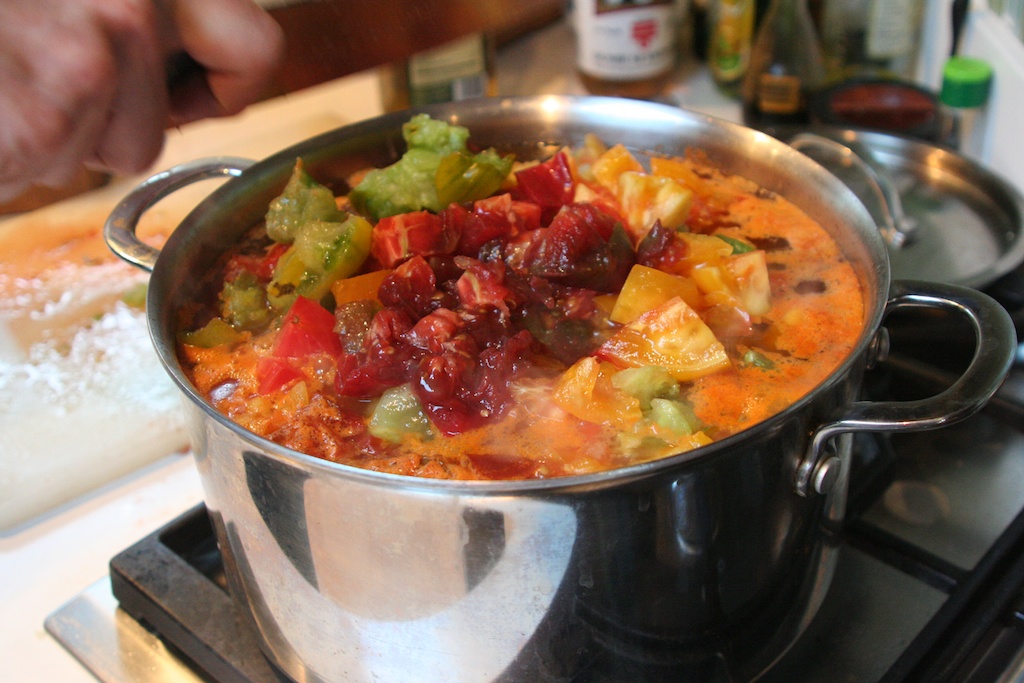
10 lbs of heirloom tomatoes on the stove, slowly transforming into sauce

My friend Debra left a message last night:

“Hi. I’ve got a cooking question. I want to make a pomodoro and I’m not sure what to do with the tomatoes. Do I blanch them first and peel them, or do I just chop them up and put them in the pan? Well, you’re not there… so I guess I’ll just have to figure it out myself. Bye!”

Fresh local tomatoes are, in my humble opinion, the greatest treasure of the summer. There are big ones, tiny ones, tart ones, sweet ones, orange and yellow and green and purple ones, some that look like teardrops and others that look like ox hearts. Perhaps, like me, you grow them yourself. I hope, unlike me, you have more than you can use and share with friends. Unlike giant zucchini, tomatoes are always a welcome gift.

Like gazpacho, a simple pasta pomodoro is a seasonal dish that highlights tomatoes at their best. Don’t do too much to this dish, and don’t make it in January. It will be utterly unlike the metallic, chemically tasting pomodoro you’ve ordered at Olive Garden. Better, even, than your favorite jar tomato sauce from Trader Joe’s.

Now back to Debra’s question — to blanch and peel or chop up — I would do neither. I prefer an even simpler method. I throw tomatoes in the blender, give them a rough puree, and set them to a simmer in a pan with olive oil and a bit of crushed garlic. You could add some chopped up tomatoes if you like chunks. I like it silkier. It’s kind of a philosophic question: How do you like your peanut butter — chunky or smooth? Note: skinny starlets and yoga students will love this dish.

Serves 2 (double for 4, etc.)

Pasta Pomodoro

1/2 lb dried pasta (I prefer spaghetti for this, but you can use your favorite dried pasta. Potato gnocchi also goes well with this preparation.)
2 large very ripe tomatoes (or 4 smaller tomatoes or a whole bunch of cherry tomatoes)
3 large garlic cloves, smashed
1/4 cup extra virgin olive, plus extra for drizzling
5 large basil leaves
freshly grated parmesan Reggiano (not the stuff in the green tube)
tsp crushed red pepper
sea salt

Cook the pasta in a large pot of salted water. (Please do not waste your olive oil by putting olive oil in the water.) Add spaghetti or pasta and cook until al dente. While the pasta is cooking, puree the tomatoes in the blender for about 10 seconds, more if you want a smoother sauce. Place tomatoes in a large pan over medium heat with olive oil and crushed garlic. Salt liberally to taste. (When you taste the sauce, it should taste a bit salty… it will disperse in the noodles.)

Stack the basil leaves, roll them up tightly like a carpet and then mince tightly to create a chiffonade.

When the pasta is all dente, use tongs to transfer it directly from the pasta water into the tomato sauce, which should have thickened some. (It’s good if some of the pasta water makes it into the sauce — the starches in the water will help bind the sauce to the pasta.) Turn heat to high and cook for 2 to 3 minutes, tossing frequently, until the pasta is well covered with sauce. Remove from heat.

Plate pasta between two plates, drizzle each with a little additional olive oil, then top each with a sprinkle of sea salt, a sprinkle of crushed red pepper, some freshly grated parmesan and the basil chiffonade. Serve!

(Note: pork lovers could include a crumbled up pork sausage to the sauce while it’s cooking. Seafood lovers might add 8 or 10 anchovy filets, and reduce the salt.)

Wine suggestion: a medium bodied, Italian-style red such as sangiovese or zinfandel.

Aloha at Home, Wherever You May Be

Growing up in Southern California, my family would go to Maui a couple times a year. And I developed a love for Hawaiian food. There’s something both comforting and essential about digging into teriyaki chicken thighs or Korean short ribs draining sweet soy goodness all over a mound of overcooked white rice, the toothsome chew of mayonnaisey macaroni salad, the tangy interplay of tomato, onion and lomi lomi salmon, and lots of fresh tropical fruit to clear the palate.

It’s hot and muggy in Topanga today. Tonight my family is eating Hawaiian. Just cuz I’m in a mood. I’ll put on iTunes and stream some traditional Hawaiian music — I like KKCR community radio out of Hanalei, Kauai … they sometimes speak Hawaiian, and even the commercials are relaxing, or AM 940 Hawaii. Maybe I’ll mix some fruity tropical rum drinks, or maybe just cold lager.  That’s how we haoles roll when we’re gettin’ our aloha on.

Here’s what we’re eating. Wanna join us on the islands? It’s fun and the kids will love it, especially if they’ve been to Hawaii. Just scroll down for the recipes, and mahalo

Teriyaki chicken, mac salad, rice and lomi lomi salmon, fresh fruit, lau lau (pork and fish cooked in taro leaves)

Serves 4, including the keiki (lil’ ones).

Hawaiian Dinner
You can make the macaroni salad, rice and lomi lomi salmon well ahead, so all you’re cooking at dinner time is the chicken. If you want to have a Hawaiian dinner party, increase the amount accordingly. (Double for eight people, etc.)

Teriyaki Chicken

1 1/2 lb skinless, boneless chicken breasts (you can also use the same amount of thinly sliced beef short ribs on the bone — Korean style — for a meat dinner)
1 thumb-sized piece fresh ginger, grated
1/4 cup chopped onion
1/4 cup low sodium soy sauce
2 tbsp ginger

Grate ginger with a cheese grater or zester. Place into large bowl, add soy sauce, onion and sugar, stir together and let sit for 5 minutes. Toss chicken in mixture, and let marinate for a couple hours in the fridge. Turn the grill onto high heat, let it get nice and hot, and grill chicken for about 5 minutes each side, until golden and brown. Spoon extra marinade and onions on as you cook. You can keep warm in a 200-degree oven while you plate the other stuff. Before serving, slice each thigh across the grain with a very sharp knife into 3 or 4 pieces.

Lomi Lomi Salmon

1/3 pound very fresh salmon, chopped into dice and salted
1 very ripe tomato
1/4 cup chopped sweet onion
sprinkle Japanese togarashi pepper (if you’ve got it)

Sprinkle about half a teaspoon of salt on your chopped salmon about an hour before you pull the dish together. After the hour, toss the salmon with the onion, tomato and pepper. Taste to see if it is salty enough. Cover and place in fridge until ready to use.

Island Macaroni Salad

1 cup dried macaroni, cooked to al dente
2 heaping tbsp mayonnaise (about 1/4 cup)
1/4 cup chopped celery
1/4 cup chopped sweet onion
2 tbsp chopped Italian parsley
dash of soy sauce
salt & pepper

Cook your macaroni until al dente and drain. Toss with a little olive oil and let cool. Once the macaroni is cool, toss in a bowl with the celery, onion, parsley and soy sauce. Add salt and pepper to taste, cover and place in the fridge until you’re ready to serve. (Note: you could give this an Asian touch with a dash of sesame oil, some sliced sugar snap peas and a bit of minced cilantro. Although I think, why mess with simple perfection?)

Rice and fruit

Steam some long grain rice according to directions well before hand (give it an extra bit of water and an extra 2 or 3 minutes on the stove), and leave sitting covered until ready to eat. It’s okay to serve it at room temperature. Slice up plenty of fresh pineapple, mango, banana, guava or other Hawaiian fruits.

To serve:

Spoon a big scoop of rice and mac salad on each plate, place some sliced teriyaki chicken next to the rice, and a bit of lomi lomi salmon next to that.

Previous Older Entries Next Newer Entries