Five Senses

When I do a cooking class, one of the most important bits of wisdom I can give students is that food should engage all five of the senses. It can be the most intricately prepared dish in the world, it can be delicious. But if it has an off-putting smell, the experience is ruined. Food should be engage your mouthfeel — which is why silky food such as risotto often benefit from a bit of crunch. The sound of diners enjoying their food should be like a symphony. And perhaps most important, food should be beautiful to look at. No one wants to eat gray mush, no matter how good it may taste.

Follow a recipe, and you’ll often get a delicious result. But the look of your dish is more of an intuitive thing. It’s more of an art. And there are simple things you can do to make a dish look beautiful. Consider colors. If your dish looks dull, add a shaving of carrot, or some purple garlic chive flowers from the garden. A drizzle of brilliant green extra virgin olive oil is often the finishing touch on one of my dishes. Or a dark swath of complex Indonesian kecap manis.

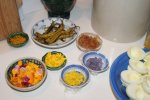
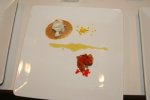
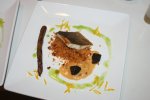
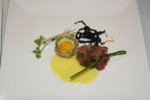
Here are some photos of my annual New Year’s Eve dinner. Another important tip for students is to have your mise en place in place before you begin. More about that in another post. I’ve included a shot of my NYE mise en place. All the “beautification” of these dishes involved relatively simple steps — a few flower petals, a drizzle of sauce, etc.
Perhaps most importantly when you cook are some of those other senses we often forget — your sense of wonder, your sense of play, and your sense of adventure. Eat to live, but more to the point, live to eat!

Fusion or Confusion?

Once years ago I was sitting with my friend, Dan, having a beer at the bar at P.F. Chang’s. He said, “You know what no one has tried yet? Mexican sushi!” I said, “Well, there’s probably a reason for that. What’re you thinking — like carnitas sushi?” It because a running joke. But who would’ve predicted Korean beef tacos?

Sometimes fusion cuisine can be good. Sometimes it works. Witness Nobu Matsuhisa introducing butter and Peruvian ingredients to his Japanese cuisine. More often than not, the successful fusion comes about that way — an inspired chef melding influences with a subtle hand. Too often, unsuccessful fusion is a marketing idea gone awry — an uncomfortable collision of cultures. North African ideas, say, superimposed over French preparations. The ascension of fusion to a global trend over the past decade has resulted in all sorts of ill-advised pairings — Asian fajitas and Caribbean pizzas. Some of the worst offenders even put “fusion” in their restaurant names.

Of all the fusing — or “infusing”, I prefer to think of it in a less egregious approach — I find what works best is the transference of certain Asian (particularly Japanese) ingredients or techniques with those of France and Italy.

The following, a recipe of my own, combines Japanese, Italian and Indonesian ingredients and preparations. The key to its success is the subtlety. I would call the dish Italian in spirit, with hints of Asia. The broiled black cod is a traditional Japanese fish and style of cooking, the potatoes and Swiss chard veering Mediterranean, and the complex kecap manis an Indonesian touch tying it all together. (I will do another post on kecap manis, the “miracle ingredient” of Indonesian cooking. You would do well to find yourself a bottle.)

Broiled Black Cod with Roasted Garlic Mashed Potatoes

Filets of black cod (Chilean sea bass would work well, too)
potatoes, peeled and boiled
head of garlic
Swiss chard
olive oil
meyer lemon
milk
butter
kecap manis
sea salt & pepper

Roast garlic head until golden. Remove from cloves and mash into potatoes with a little milk, butter and salt & pepper. Place in a dish and keep warm in oven. Place black cod fillets on foil and broil in the oven. Meanwhile, chop Swiss chard and sauté in olive oil. Keep warm on a very low flame. When cod is roasted to a golden brown, turn off oven. To plate:  Place a circle of swiss chard, topped with a circle of potato mixture, then place black cod on top.

To sauce: heat juice of a meyer lemon in a small pan. Remove from heat, and melt in half a stick of butter, stirring constantly, until velveted. Drizzle over top of fish, and then create a circle design around fish with drizzle of kecap manis.

Mindfulness (Or Throw Nothing Out)

I was giving a cooking lesson to my friend Tracy’s “gourmet group” recently, and was telling the ladies about cooking a duck and using every part of it — the meat, the skin, the liver, the bones — and getting some winces from the girls. (I know, ducks are cute…) But I was making a point of not wasting and using as much as you can of an animal that has died for your sustenance (and/or pleasure). It’s the sacred thing to do.

My wife and I once had a grilled fish on the beach in Mazatlan — it took the guy 2 hours to cook it, he told us his story, about his life and family, gave us Pacificos, and finally presented the grilled fish in all its glory. We felt honored to be eating it, squeezed with lime, drizzled with salsa, wrapped in tortillas. This is what eating should be. I cooked a whole Japanese sea bass on the grill a few nights ago, head and all. We picked the meat from the bones, just like in Mazatlan, made tacos. Then I threw the bones and head into a pot of water with an onion, bay leaf, celery found limp in the veggie drawer… and made a stock. I froze the stock in ziploc bags to have when I want it for fish soup, paella, whatever. Most people would’ve simply thrown the bones away. But respecting the animal is the sacred thing to do. And you get a few more meals out of it, which in difficult economic times is also the smart thing to do.

I was at dinner at a friends house a few weeks ago. She bought a roast chicken somewhere, served us the meat, and was getting ready to throw the bones away. “Can I have those?” I said. The bones from a roast chicken you buy at the market or wherever will make the BEST chicken stock you’ve ever had. Throw it in water with an onion, carrot and bay leaf, some salt, simmer for an hour or so, and strain.

Mindfulness is the most important aspect of cooking. Mindful of your ingredients and their freshness. Mindfulness of the seasons. Mindfulness of your body and what you put into it. People along the Adriatic eat lots of fresh fish, they pour olive oil liberally over EVERYTHING, they eat pork and beef grazed on the farms around them, they eat fresh butter and greens foraged from the hills, or that they grew themselves. They linger hours over their meals, conversing,  and drink more wine than the average American. And they live longer than anyone else on earth.

The Importance of Salt

Salt. The quintessential seasoning. In use since the day that first cave guy realized that the yak carcass tasted better and lasted longer if you sprinkled it with the white crystal you gathered down by the coast.

Snow-powdery Maldon salt

Not all salts are created equal. If you use that round canister with the girl with the umbrella on it, I will ban you from visiting this post. The culinary world these days is filled with every manner of salt from every corner of the world. Most of it is not worth your time. But feel free to experiment and find the salts you like best. There are black smoked salts, red lava salts, pretty pink salts from Australian rivers, smelly sulfurous salts from the Himalayas, you name it. Here’s my two most important salts:

KOSHER

This is the workhorse. Every kitchen should have Kosher salt as their main salt. It works well for cooking and is flaky and light for sprinkling. Morton’s (the kind with the girl and the umbrella) makes a good Kosher salt (NOT in a canister) that I like.

MALDON

This is the finest salt, in my opinion, for sprinkling. I use relatively little salt when I cook, and prefer to season afterward. And this is my seasoning of choice for fine cooking. It comes from England and is formed of these gorgeous little pyramid crystals. It’s like crystal snow on your food, with the most elegant, sexy little crunch. And it’s not as expensive as some of those other salts that the folks at Williams-Sonoma will try to convince you that you can’t live without.

RUNNERS-UP

I also like the French classic, fleur de sel, as well as that pink river salt from Australia. Some of the Hawaiian salts are nice, although the crystals tend to be a little large and hard for my taste. But experiment and see which salts you like best on your food.

Next Newer Entries