This Old Pan

When I was in my 20s, I moved into a rent control apartment in Santa Monica with my skinny yoga teacher sister. $630 for a two-bedroom close to the beach, you couldn’t beat it. The apartment was in a semi-advanced state of runned-downess, with a crummy old stove. The guy vacating was an older cat, and he’d left behind just a few odds and ends not worth packing up. One of them was a baking dish of an unknown metal, misshapen and blackened. It never even made it out of the oven.

The pan

Some of the best kitchen tools are those with the most mojo. An old cast iron pot passed down from your grandmother, for example, or a ricer you pick up at a thrift shop. I didn’t know it at the time, but this old pan not worthy of being packed for a move would fit the bill.

Several times over the near decade I’ve been married, my wife has tried to throw it away. She wanted it gone when we were still in that apartment, and with the two subsequent moves suggested perhaps it was time to retire the pan. Many a birthday or Christmas she has asked if perhaps I would like a new baking pan. It’s sort of like the classic cliché of the wife trying to get rid of the husband’s comfy old flannel shirt or holey t-shirt.

What do I love about the pan? Nothing in particular. But it works. It’s got a patina from ages of blazing hot oil that renders it virtually non-stick. It’s shape is useful — it’s long enough to fit a porchetta or a duck, and its sides are tall enough that stuff doesn’t spill. It’s not fussy — I can tell it feels equally at home being part of an elegant short rib braise, or catching drippings from the kids’ chicken nuggets. And maybe best of all, I never worry about ruining it the way I do some of my other, fancier, newer cooking vessels.

These are things to consider next time you think about upgrading your old pan. Sometimes what you’ve got is better than what’s out there — a good lesson for a lot of areas of our life. And the landfill doesn’t really need one more old pan retired before its time.

The Sacred Soups of Sunday

Sunday is a sacred day, for different reasons for different people. My wife was raised in church, she likes to dress up and go to a service. For some people, it’s a football game and maybe a tailgate party. (I understand the appeal of both these traditions.) I like to take it slow — make a rich pot of smooth Hawaiian coffee, read the paper. And sometimes, I like to make soup.

Soup isn’t a breakfast in America the way it is in other countries. America is missing out. There’s nothing as spiritually nourishing on a Sunday morning, particularly if it’s chilly out or you’ve happened to have drank a bit too much on Saturday night, as a rich steaming bowl of soup. Sometimes when I’m in a clean mood, I like miso soup with crispy bits of tempura batter (tenkasu) sprinkled on top. As part of a traditional Japanese breakfast with pickles and fish and rice, it’s dynamite. But the Sacred Sunday Soups I’m talking about are the heartier kind — where you can eat them in the late morning and want nothing else until dinner time. Throughout the world there are examples, but the two I fall back on the most come from Mexico and China, respectively. I’m talking about pozolé and congee.

Pozolé is the name of the large corn kernals (hominy) you’ll find floating in the soup. It’s also the name of the soup. It means “foamy” in the Nahualt language. Don’t be intimidated. It is a typical dish of various Mexican states across the country, and corn being sacred in traditional Mexican culture, it is often served on holidays. You begin with one of those cheap pork shoulders I often talk about in this blog. You cook it for hours in water, then make carnitas with the meat. The broth becomes this rich, spicy soup with the corn kernels and meat and condiments. I’ll tell you how to make it after I tell you about the other soup.

The other soup is congee, which you may have had before if you like going to those big dim sum palaces where they wheel the carts around. Congee is a rice porridge with condiments — it’s ridiculously easy to make, requiring nothing more than rice, a good chicken broth, a hunk of ginger and some bits of pieces of stuff to put into it. I’ll tell you how to make it after I tell you how to make pozolé.

Both these soups soothe the soul, make great leftovers, and can feed a whole bunch of people impressively. Next time you want to see some friends, instead of having a dinner party, have a Sunday brunch and serve pozolé or congee. It’s the sacred thing to do.

Pozolé

1 pork shoulder, 3-5 lbs, with bone
2 onions
1 bay leaf
salt
1 small can hominy
2 dried chili pasilla
2 cloves garlic
1 small bunch cilantro
3 fresh jalapeño or serrano chilies
4 radishes, sliced thinly
3 tbsp dried oregano
lime wedges

THE DAY BEFORE: Cook the pork shoulder in a pot of water with the onion and bay leaf and salt to taste. Cook for a couple hours, until the water has reduced by about half and the pork is fork tender. Strain the broth into another pot. When cool, place in the fridge overnight. Take the pork shoulder when cool, cut the meat off into cubes and place in the fridge.

The next morning, take the broth out, and skim the fat from the top. Place the pork chunks in a baking dish, toss with the skimmed fat and some salt, and roast in a 400-degree oven, tossing the meat occasionally, until it’s golden (or about 45 minutes). This will be your carnitas, which you can eat with salsa in flour tortillas for tacos. You can store in a tupperware in the fridge or freeze and save for later.

Reheat the broth, setting aside 1 cup. Drain can of hominy and add to broth. Place the pasilla chilies in the broth to reconstitute. Once the chilies are soft, remove stems and seeds and puree in a blender with half an onion and garlic cloves. Add puree to the broth. Shred up some of the carnitas meat and add that to the soup. Simmer on low heat until ready to eat. Once you are ready (soup can be made a day or two ahead, and gets even better sitting in the fridge), serve in bowls with other listed ingredients as condiments for each diner to add at his or her discretion — half onion chopped with cilantro, chopped fresh chilies, dried oregano, sliced radishes and lime wedges for squeezing over soup.

Congee

(The following is for two people. For more, multiply the recipe according to numbers)

1 quart good chicken stock (preferably homemade)
1/4 cup long-grain rice
thumb-size nub of fresh ginger, crushed with the flat side of a knife
2 eggs
2 tbsp chopped peanuts
2 tbsp chopped cilantro
2 dried arbol chilies, toasted
2 tbsp chopped pork or chicken meat
soy sauce

Heat chicken stock in a pot with ginger. Add rice and simmer over low heat for 30 minutes until porridgey. Remove ginger. Crack two eggs gently into the soup, turn off heat, and cover for five minutes.

Serve with other listed ingredients as condiments in small bowls, for each diner to add at his or her discretion. Toast the chilies over the flame of a stove until they begin to blacken, and crush into a small bowl. (Note: I’ve done variations on this recipe, using duck stock instead of chicken, with chunks of duck meat. I’ve used Szechuan peppercorns as a condiment, and slices of ginger. You can experiment and add your own inspired additions.)

The Great Lard Freak Out

I remember the Great Lard Freak Out of the 1980s. People suddenly discovered that flour tortillas were being made with lard! (As they had been for centuries in Mexico, but anyway…) Suddenly lard was the culprit in a world of food ills. Much the same as MSG had been. “Our food made with NO LARD!” signs in Mexican restaurants would proclaim.

I don’t want Mexican food made without lard.

I believe quinoa was the progeny of this period of food freak out. So was margarine, which is one of the most terrible products on earth — and far worse for you than lard. But lard retains its stigma. For skinny girls and starlets/yoga students, it’s the mayonnaise of meat products. There’s a cured Italian meat called “lardo,” but you’ll be hard-pressed to get any but the most adventurous eaters to try it. “Lardo??” your friends will say, “As in ‘LARD’!??”

Man cannot live on lard alone. Certainly if you ate too much of it you’d be courting problems. But that could be said of most foods (quinoa aside). The key to everything is moderation. A little lard in a tamale or tortilla isn’t gonna kill you — it’s gonna likely be better than the shortening used instead, and it’s going to taste a heck of a lot better. It amazes me that people put synthetic non-dairy creamer in their coffee. My cream come from a cow, where does your non-dairy creamer come from? A chemical factory. And you’d rather put THAT in your body?

You should seek out the things that taste good and natural in life, and eat them. When you want something creamy, eat cream. Eat a gelato, not a fat-free Splenda dessert. When you want healthy, eat a carrot. Eat good things in moderation. Stop eating before you are full, learn to be satisfied rather than gorged. If people could learn this in every area of their lives, we wouldn’t have subprime mortgage crises, epidemic obesity or skyrocketing personal bankruptcies. Eat food that is fresh, in season and local — tomatoes will taste better in July, and they won’t bear a brontosaurus-size carbon footprint after their transcontinental trip from Peru.

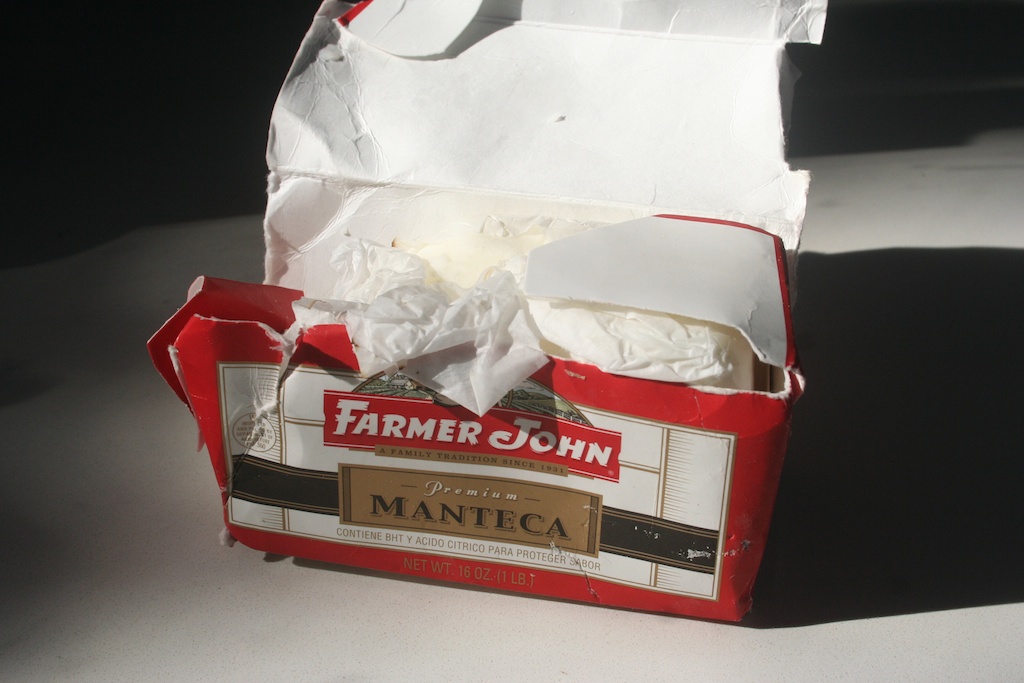
I keep a cube of Farmer John’s lard in my freezer — the kind in the red box you see at the grocery store that says “manteca” on it. It’s been there for a year or so. Every once in a while, when I’m making tamales or certain other dishes, I pull it out and shave a little off into the recipe. It makes the food taste a whole lot better. And it’s not going to kill me as fast as skinny girl’s Country Crock.

Next time you’re in a Mexican restaurant and are contemplating ordering a dish, ask if it has lard in it. If the waiter says yes, you say: “Thank you. That’s what I’ll have!”

Marketing

I remember being in Paris once when I was a kid. I was amazed that between our Metro stop and the flat where we were staying — which was about a block — there were a variety of markets. And I would see people coming home from work, exiting the Metro station, and ponging between market and market. They’d pick up a baguette at the boulangerie, stopping at the fromagerie for cheese, picking up some veggies at another market. Each day on their way home, they would pick up everything they needed for that night’s dinner. What a revelation this was for a kid used to going to the supermarket once every two weeks with his dad to stock up.

I often stop at three or four markets a day, myself — although I’m driving all over Los Angeles versus walking the block between Metro and home. I’ll hit the Japanese market for fish and ponzu sauce and croquettes for the kids and rice and sake and beer, go to the Sanchez carniceria for their killer salsa roja and tortillas, stop at Bay Cities Italian Deli to get pancetta and dried pastas and bottarga di mugine, and drop into Trader Joe’s for everything else. I may even stop at Whole Foods for a $15 piece of cheese. I go to the Farmer’s Market a couple times a week to get the produce that I am unable to grow myself — which, to be honest, is most of it.

If you go to the market fewer than three times a week, you are doing something wrong.

Five Senses

When I do a cooking class, one of the most important bits of wisdom I can give students is that food should engage all five of the senses. It can be the most intricately prepared dish in the world, it can be delicious. But if it has an off-putting smell, the experience is ruined. Food should be engage your mouthfeel — which is why silky food such as risotto often benefit from a bit of crunch. The sound of diners enjoying their food should be like a symphony. And perhaps most important, food should be beautiful to look at. No one wants to eat gray mush, no matter how good it may taste.

Follow a recipe, and you’ll often get a delicious result. But the look of your dish is more of an intuitive thing. It’s more of an art. And there are simple things you can do to make a dish look beautiful. Consider colors. If your dish looks dull, add a shaving of carrot, or some purple garlic chive flowers from the garden. A drizzle of brilliant green extra virgin olive oil is often the finishing touch on one of my dishes. Or a dark swath of complex Indonesian kecap manis.

Here are some photos of my annual New Year’s Eve dinner. Another important tip for students is to have your mise en place in place before you begin. More about that in another post. I’ve included a shot of my NYE mise en place. All the “beautification” of these dishes involved relatively simple steps — a few flower petals, a drizzle of sauce, etc.

Perhaps most importantly when you cook are some of those other senses we often forget — your sense of wonder, your sense of play, and your sense of adventure. Eat to live, but more to the point, live to eat!

Previous Older Entries Next Newer Entries