Spaghetti, 101 (My Fave Five)

Carbonara

Has there ever been a more perfect, versatile food than spaghetti? Layer-upon-layer of flavors emerging from within coiled strands of toothsome semolina goodness… In Italy, spaghetti is ubiquitous, dressed in myriad creative ways far beyond that ol’ American standard of greasy meatballs and heavy tomato sauce obscuring overcooked noodles. In Italy, it’s the noodle they celebrate more than the sauce. As Mario Batali says, the sauce is the “condiment.” Scroll down a bit and you’ll find recipes for five of my favorite “condiments” — easy, wonderful dishes you can make in as little as 10 minutes!

Meanwhile, here’s three of the best tips you’ll ever get about cooking spaghetti (or any pasta, for that matter):  1.) Salt your water generously before you start cooking the pasta. I typically throw in a heaping tablespoon. 2.) ALWAYS save the pasta water you have cooked the spaghetti in. Very rarely should you actually drain the spaghetti — lift it out instead with tongs and drop it in the sauce. You’ll use the water to moderate the sauciness of your pasta. 3.) DO NOT add olive oil to your pasta water. This is a waste of oil and money. The way to keep your pasta from sticking together is to stir it the first couple minutes it’s in the water, and then once or twice while it’s cooking.

I like to cook a half pound of spaghetti — you can feed 2-4 people (or 10-12 yoga students), depending on how hungry they are. So all of the following recipes are based on cooking a half pound. You could double it to serve more, or to have tasty leftovers in the fridge. (I’m a big tasty leftover guy, myself…) Don’t forget, you’ll want to save the pasta water for several of these recipes.

(Note: Because of ingredients such as butter and pork, several of these recipes will NOT be starlet- or skinny-yoga-student friendly. If you are serving a starlet or skinny yoga student, substitute quinoa for the spaghetti, expeller-pressed sunflower oil for the butter and tempeh for the pork.)


Spaghetti with Butter, Pepper and Parmesan

This is the simplest and perhaps most wonderful of all. You can also substitute 1/4 cup good fruity extra virgin olive oil for the butter if you’d like a lighter, more healthy pasta. But remember, don’t be afraid of butter. And the better quality the butter, salt and cheese, the better the final results. I use Italian butter from the same Parma cows that make Parmesan, Maldon salt and aged Parmesan Reggiano.

1/2 lb spaghetti
1/2 stick butter (1/4 cup)
flaky sea salt and pepper
freshly grated good Parmesan Reggiano cheese

Cook pasta to al dente. Drain briefly in a collander (do not rinse!) Return pasta to cooking pot, toss with butter until all butter is melted. Sprinkle with salt and pepper, toss again, and plate. Top with generous amount of grated Parmesan Reggiano and serve. (You could also sprinkle some chopped Italian parsley over the top for a hint of freshness.)

Spaghetti Carbonara

This is the traditional preparation, which is a whole different animal than the gummy cream-based version you’ve come to know at Olive Garden’s all-you-can-eat pasta bar.

1/2 lb spaghetti
3 oz pancetta (or bacon)
2 tbsp olive oil
1/2 cup grated Parmesan Reggiano, plus extra for grating
1 whole egg and one egg yolk
flaky sea salt and pepper

While pasta water is heating, cook pancetta or bacon to crisp in a pan with olive oil, remove to drain on paper towels and reserve fat in the pan. Cook spaghetti to al dente. Remove with tongs to the pan with the pancetta or bacon fat, bringing a couple tablespoons of pasta water with you. Add pancetta or bacon, broken up into pieces, and heat briefly over high heat, stirring. Remove from heat. Add egg and extra egg yolk and 1/2 cup of Parmesan, and toss to mix. Divide among plates and top with more grated Parmesan, salt and freshly ground pepper.

Spaghetti with Sauteed Greens

This starlet-approved crowd pleaser is perfect for those spontaneous after-yoga-class dinner parties.

1/2 lb spaghetti
1 bunch swiss chard, tuscan black kale or beet greens
3 cloves garlic
1/4 cup olive oil plus extra for drizzling
1 tsp crushed red pepper
flaky sea salt and pepper
Parmesan Reggiano

Cook spaghetti to al dente. While spaghetti is cooking, chop your greens roughly into large pieces. Smash garlic cloves with back of a knife, break up and cook over medium heat in olive oil. As garlic begins to turn golden, add crushed red pepper and toss. Add greens and sauté for five minutes, with a dash of salt, until greens are cooked. Drain pasta, adding 1/4 cup of the pasta water to your greens. Add pasta and cook over high heat for about a minute, or until sauce thickens and binds to pasta. Remove from heat and divide among plates.

Spaghetti with Fresh Clams

You could also use the more familiar linguini in this preparation, which will NOT remind you of the version your grandma in Jersey used to make when you were a kid.

1/2 lb spaghetti
1 lb fresh clams in their shell, scrubbed
3 cloves garlic, crushed with the back of a knife
1 small Spanish chorizo (see La Española Meats under “Links” to order)
1/2 cup wine
1/4 cup olive oil
1/4 cup chopped Italian parsley
flaky sea salt and pepper
Parmesan Reggiano

Cook the spaghetti to al dente. While it’s cooking, slice up the chorizo and cook slices in olive oil over medium heat. Break up crushed garlic and add to pan. Add clams and wine, turn heat to medium high and cover. Cook for about 5 minutes, or until all the clams have opened. (Discard any that do not open.) Remove cover and simmer over low heat. When spaghetti is done, transfer from pot to the pan with tongs. Add a little pasta water if needed. Turn heat to high and cook, tossing, for one minute. Remove from heat. Toss in parsley and season to taste with salt and pepper. Plate the pasta, dividing the clams evenly, and top with some freshly grated Parmesan.

Spaghetti with Tomatoes and Sausage

The simplicity of tomato and pork. You could use turkey or chicken Italian sausage for this if you wanted to. Use colored heirloom tomatoes — green zebra, for example, or golden pineapple — for a vibrant, alternate colored sauce.

1/2 lb spaghetti
1 sweet Italian sausage (or hot if you prefer)
1/4 cup olive oil
3 garlic cloves, smashed with the back of a knife
2 very ripe large tomatoes
flaky sea salt
crushed red pepper
Pecorino Romano

Cook spaghetti to al dente. While pasta is cooking, puree tomatoes in a blender. Remove sausage from casing. Heat olive oil in a pan over medium heat, and cook garlic for 1 minute. Add sausage, breaking up with the back of a wooden spoon as it cooks. Once sausage and garlic have begun to turn golden, add tomato puree and season with salt. Cook over medium heat until sauce thickens. When spaghetti is done, transfer from water to sauce pan, and turn heat to high. Cook for a minute or two, tossing, until the pasta is coated. Dish onto plates, sprinkle with a bit of crushed red pepper and salt to taste, and top with grated Pecorino Romano.
The Sacred Soups of Sunday

Sunday is a sacred day, for different reasons for different people. My wife was raised in church, she likes to dress up and go to a service. For some people, it’s a football game and maybe a tailgate party. (I understand the appeal of both these traditions.) I like to take it slow — make a rich pot of smooth Hawaiian coffee, read the paper. And sometimes, I like to make soup.

Soup isn’t a breakfast in America the way it is in other countries. America is missing out. There’s nothing as spiritually nourishing on a Sunday morning, particularly if it’s chilly out or you’ve happened to have drank a bit too much on Saturday night, as a rich steaming bowl of soup. Sometimes when I’m in a clean mood, I like miso soup with crispy bits of tempura batter (tenkasu) sprinkled on top. As part of a traditional Japanese breakfast with pickles and fish and rice, it’s dynamite. But the Sacred Sunday Soups I’m talking about are the heartier kind — where you can eat them in the late morning and want nothing else until dinner time. Throughout the world there are examples, but the two I fall back on the most come from Mexico and China, respectively. I’m talking about pozolé and congee.

Pozolé is the name of the large corn kernals (hominy) you’ll find floating in the soup. It’s also the name of the soup. It means “foamy” in the Nahualt language. Don’t be intimidated. It is a typical dish of various Mexican states across the country, and corn being sacred in traditional Mexican culture, it is often served on holidays. You begin with one of those cheap pork shoulders I often talk about in this blog. You cook it for hours in water, then make carnitas with the meat. The broth becomes this rich, spicy soup with the corn kernels and meat and condiments. I’ll tell you how to make it after I tell you about the other soup.

The other soup is congee, which you may have had before if you like going to those big dim sum palaces where they wheel the carts around. Congee is a rice porridge with condiments — it’s ridiculously easy to make, requiring nothing more than rice, a good chicken broth, a hunk of ginger and some bits of pieces of stuff to put into it. I’ll tell you how to make it after I tell you how to make pozolé.

Both these soups soothe the soul, make great leftovers, and can feed a whole bunch of people impressively. Next time you want to see some friends, instead of having a dinner party, have a Sunday brunch and serve pozolé or congee. It’s the sacred thing to do.

Pozolé

1 pork shoulder, 3-5 lbs, with bone
2 onions
1 bay leaf
salt
1 small can hominy
2 dried chili pasilla
2 cloves garlic
1 small bunch cilantro
3 fresh jalapeño or serrano chilies
4 radishes, sliced thinly
3 tbsp dried oregano
lime wedges

THE DAY BEFORE: Cook the pork shoulder in a pot of water with the onion and bay leaf and salt to taste. Cook for a couple hours, until the water has reduced by about half and the pork is fork tender. Strain the broth into another pot. When cool, place in the fridge overnight. Take the pork shoulder when cool, cut the meat off into cubes and place in the fridge.

The next morning, take the broth out, and skim the fat from the top. Place the pork chunks in a baking dish, toss with the skimmed fat and some salt, and roast in a 400-degree oven, tossing the meat occasionally, until it’s golden (or about 45 minutes). This will be your carnitas, which you can eat with salsa in flour tortillas for tacos. You can store in a tupperware in the fridge or freeze and save for later.

Reheat the broth, setting aside 1 cup. Drain can of hominy and add to broth. Place the pasilla chilies in the broth to reconstitute. Once the chilies are soft, remove stems and seeds and puree in a blender with half an onion and garlic cloves. Add puree to the broth. Shred up some of the carnitas meat and add that to the soup. Simmer on low heat until ready to eat. Once you are ready (soup can be made a day or two ahead, and gets even better sitting in the fridge), serve in bowls with other listed ingredients as condiments for each diner to add at his or her discretion — half onion chopped with cilantro, chopped fresh chilies, dried oregano, sliced radishes and lime wedges for squeezing over soup.

Congee

(The following is for two people. For more, multiply the recipe according to numbers)

1 quart good chicken stock (preferably homemade)
1/4 cup long-grain rice
thumb-size nub of fresh ginger, crushed with the flat side of a knife
2 eggs
2 tbsp chopped peanuts
2 tbsp chopped cilantro
2 dried arbol chilies, toasted
2 tbsp chopped pork or chicken meat
soy sauce

Heat chicken stock in a pot with ginger. Add rice and simmer over low heat for 30 minutes until porridgey. Remove ginger. Crack two eggs gently into the soup, turn off heat, and cover for five minutes.

Serve with other listed ingredients as condiments in small bowls, for each diner to add at his or her discretion. Toast the chilies over the flame of a stove until they begin to blacken, and crush into a small bowl. (Note: I’ve done variations on this recipe, using duck stock instead of chicken, with chunks of duck meat. I’ve used Szechuan peppercorns as a condiment, and slices of ginger. You can experiment and add your own inspired additions.)

The Great Lard Freak Out

I remember the Great Lard Freak Out of the 1980s. People suddenly discovered that flour tortillas were being made with lard! (As they had been for centuries in Mexico, but anyway…) Suddenly lard was the culprit in a world of food ills. Much the same as MSG had been. “Our food made with NO LARD!” signs in Mexican restaurants would proclaim.

I don’t want Mexican food made without lard.

I believe quinoa was the progeny of this period of food freak out. So was margarine, which is one of the most terrible products on earth — and far worse for you than lard. But lard retains its stigma. For skinny girls and starlets/yoga students, it’s the mayonnaise of meat products. There’s a cured Italian meat called “lardo,” but you’ll be hard-pressed to get any but the most adventurous eaters to try it. “Lardo??” your friends will say, “As in ‘LARD’!??”

Man cannot live on lard alone. Certainly if you ate too much of it you’d be courting problems. But that could be said of most foods (quinoa aside). The key to everything is moderation. A little lard in a tamale or tortilla isn’t gonna kill you — it’s gonna likely be better than the shortening used instead, and it’s going to taste a heck of a lot better. It amazes me that people put synthetic non-dairy creamer in their coffee. My cream come from a cow, where does your non-dairy creamer come from? A chemical factory. And you’d rather put THAT in your body?

You should seek out the things that taste good and natural in life, and eat them. When you want something creamy, eat cream. Eat a gelato, not a fat-free Splenda dessert. When you want healthy, eat a carrot. Eat good things in moderation. Stop eating before you are full, learn to be satisfied rather than gorged. If people could learn this in every area of their lives, we wouldn’t have subprime mortgage crises, epidemic obesity or skyrocketing personal bankruptcies. Eat food that is fresh, in season and local — tomatoes will taste better in July, and they won’t bear a brontosaurus-size carbon footprint after their transcontinental trip from Peru.

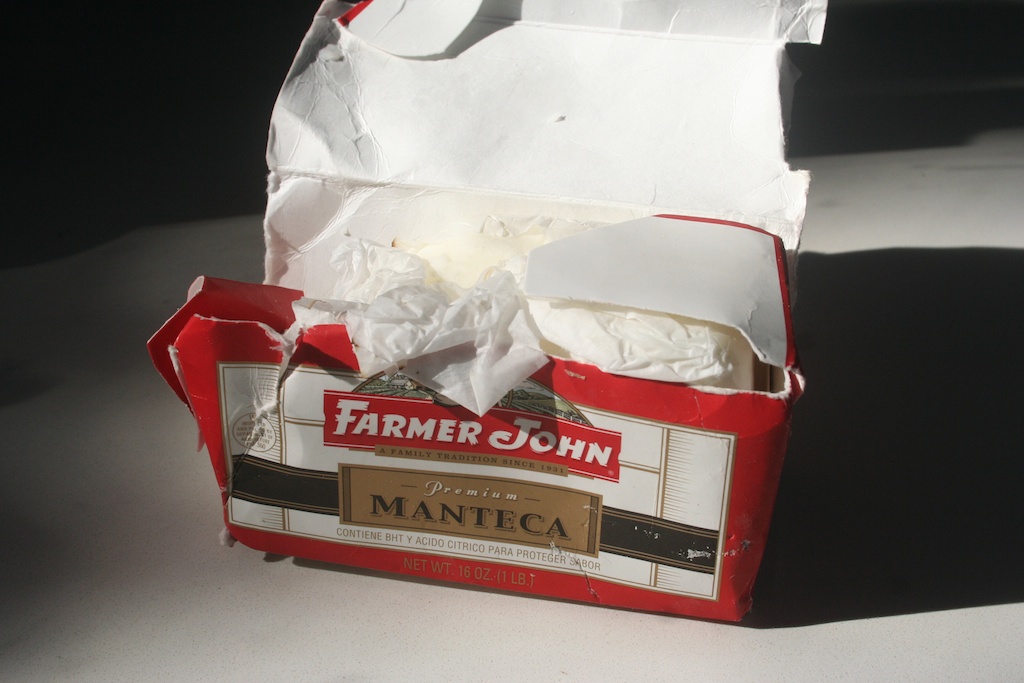
I keep a cube of Farmer John’s lard in my freezer — the kind in the red box you see at the grocery store that says “manteca” on it. It’s been there for a year or so. Every once in a while, when I’m making tamales or certain other dishes, I pull it out and shave a little off into the recipe. It makes the food taste a whole lot better. And it’s not going to kill me as fast as skinny girl’s Country Crock.

Next time you’re in a Mexican restaurant and are contemplating ordering a dish, ask if it has lard in it. If the waiter says yes, you say: “Thank you. That’s what I’ll have!”

The Torta

Do you live near a Vallarta Market? If you are in Southern California, you may be fortunate enough to have a Vallarta Market near you. It’s the Whole Foods of the Mexican community, minus the organic and the quinoa and the whole-paycheck part. The Vallarta Market is REALLY inexpensive, and has really great Mexican stuff. The prepared foods are fabulous (pick up the “Pork al Pastor” pre-marinated in the meat section, take it home and grill it up with some tortillas and their homemade salsa roja.)

Anyway, the best part of the Vallarta Market, in my humble opinion, is the Torta Cubana. You can only eat this sandwich once a year, or it will kill you. It takes two days to eat, and each time you eat it, it takes half a day to digest. But it is worth it — a bun piled with beans, fried egg, grilled ham, bacon and cheese. (And still, it’s better for you than one of those Carl’s Jr. things you see on TV.) Add some salsa and pickled jalapeños from the salsa bar in the area you go to sit and eat. And remember, eat half and take the rest home. For y’all unfortunate folks with no Vallarta Market nearby, here’s a recipe so you can make it at home:

Serves two for two days (or four):

Two kaiser rolls or other roundish, flattish bread (you could even get away with ciabatta)
two slices ham, grilled quickly in a hot pan
four pieces of cooked bacon
two eggs, fried
grated colby or cheddar
1/2 cup refried beans
1/2 small onion, chopped
1/4 cup chopped cilantro
mayonnaise
red salsa
pickled jalapeños

Slice the buns open, brush with mayonnaise, and grill in a hot pan until toasted. Add a little more mayo. Then build your torta — refried beans, topped with a fried egg, topped with a slice of ham and the bacon, topped with grated cheese and then chopped onion and cilantro. Put the top bun on. Now put a little vegetable oil (canola, sunflower, whatever) in a pan — just a little bit to create a light barrier. (This could be a good instance for one of those oil sprays I’ve seen.) Heat the pan and place the tortas in the pan to toast. Cover with a lid that is slightly smaller than the pan, so you can press the sandwiches down some. (You could use a panini grill instead if you’ve got one.) When the bottom seems lightly toasted, flip the sandwiches and grill the top. You want them a little toasty on top and bottom, and you want the cheese to begin to melt a little. Take the sandwiches off, remove the top and drizzle with some salsa and add some jalapeños, and put the top back on. Serve.

If you like to experiment, you can mix it up by trying different cheese, different meat (leftover cochinita pibil makes a great torta, as does shredded chicken).

Beverage suggestions: Cold Mexican beer, cold Mexican soda

Cochinita Pibil

Pork shoulder is the great unheralded cut of meat. And one of the least expensive in the market. Plus, it’s usually huge and you can feed a party. Cochinita Pibil is a specialty of the Yucatan in Mexico, where an entire pig is marinated in citrus juices and achiote paste, wrapped in banana leaves and cooked in an underground oven. You can do it in your own above-ground oven with part of a pig. The shoulder. You’ll need to find some achiote paste, which you can get at Mexican markets or google it online.

This dish should serve 6 – 8 people. Or serve it to fewer people and save leftovers for more tacos or to make tortas (see “World’s Best Sandwich” post).

1 pork shoulder, 3-5 lbs.
1/2 small brick of achiote paste (or about 3 tbsp)
juice of two oranges and three limes
salt & pepper
flour tortillas
red onion
habeñero peppers

So the day before you want to eat your meal, salt up the pork shoulder, and cut into big chunks. (If there’s a bone, the the bone chunk be one of the chunks.) Dissolve the achiote paste in a bowl with the juice of one orange and the three limes — this will require some serious mashing with either your fingers or the back of a spoon. Toss pork into the mixture and put in the fridge to marinate. You can also make the red onion salsa the day before — slice the onion thinly, toss with the juice from the other orange and put in a covered bowl in the fridge.

The morning of the Pibil, you’ll need some banana leaves. If you live in a warm place, you might be able to go pick some. If not, you can often get them frozen at a Mexican or Asian market. If you can’t figure out where to get them, you can use foil instead. About five hours before you wanna eat, turn the oven on to 250. Line an earthenware baking dish or some other cooking vessel with banana leaves, put the pork into the leaves, and wrap the hanging part of the leaves over the top so the pork is entirely covered. Cover top with foil. (If you don’t have leaves, just put the pork in the baking dish and cover with foil.) Let cook for 4 to 5 hours.

About 30 minutes before you’re ready to eat, turn the grill on. (If you don’t have a grill, heat a pan over medium-high heat.) Brush the tortillas with a little oil or lard, and grill quickly until they are hot and beginning to bubble. Place on a clean dishtowel and wrap them up to keep warm. Grill the habañeros until the skin begins to blacken and blister. Place your onion salsa in a nice looking bowl with a spoon. Bring the cochinita pibil to the table, set on a hot plate, and unwrap for all to see and ooh and ahh. Let each person scoop some pork into tortillas with a little onion salsa and maybe a pinch of habañero if they dare. (Note, this is the recently dethroned “hottest pepper in the world”. The new hottest pepper is some Indian pepper… but this is still pretty dang hot.)

Beverage suggestion: Cold Mexican beer, sangria, crisp white wine such as sauvignon blanc

Previous Older Entries Next Newer Entries