Sushi 101

It took me a bloody decade to learn how to properly make sushi rice. I’m going to tell you right here and now so you won’t suffer the same fate.

Crab & matsutake dynamite

Once you’ve got the rice made, the rest is paint by numbers. Although you’ve gotta have a nice sharp knife and really fresh fish, which I get at the Japanese market. They’ve got everything I could want — toro, hamachi, albacore, uni, sweet shrimp, halibut, salmon, etc. If you live in a big city you’ll have no problem finding a Japanese market with sashimi-quality fish. If you live in a reasonably good town, you should at least be able to find some sashimi-grade ahi (Trader Joe’s has sashimi-grade ahi and frozen sashimi-grade scallops, which I’m gonna tell you how to make scallop “dynamite” with…) If you live in the country, you may have to settle for cooked shrimp.

Here’s how to do the rice:

1 cup short-grain white rice (Calrose or sushi rice)
2 cups water
1 tbsp. seasoned rice wine vinegar (or 1 tbsp. rice wine vinegar and 1 tsp. sugar, mixed)

Rinse the rice in water: put the rice in the pot you intend to cook it in, and run some tap water over it. Swish it with your hand. It will become cloudy. Pour the water out, and repeat until it’s no longer cloudy (usually takes me 4 or 5 rinsings/swishings). Then cover with water and let sit for 15 minutes.

Drain the rice (all the water does not need to be drained, just most of it), add your 2 cups of water, cover and place on high heat. Once your rice begins to boil, cook for one minute. (You may need to lift the lid once or twice to prevent it from boiling over.) After the minute, turn to low, cover and cook for exactly five minutes. Once the five minutes is up, turn heat to high again and cook for 30 more seconds. Turn off and leave sitting, covered, for 20 minutes.

When the 20 minutes is up, remove lid and add vinegar, stirring very gently with a wooden spoon or spatula without breaking the rice kernels. When done, spread the rice within the pan and cover with a damp towel until ready to use.

For sushi, you’ll slice your piece of fish width-wise across the grain into sashimi-size pieces. Then you dampen your hands, take about a heaping teaspoon of rice in one palm, place two fingers from the other hand on top of it and fold your hand around it to form a small sushi rice patty. Repeat until you have as many rice balls as you have fish slices. Smear each with a dab of wasabi and place your sushi on top. “Irasshaimase!!!”

Or, you can make the ever-popular scallop dynamite, which I might happily point out makes ample use of mayonnaise (I made it in the above picture with king crab instead of scallops, and delicious matsutake mushrooms which are available in the fall at Japanese markets or in the woods near my mom’s house):

*   *   *

Scallop Dynamite

1/2 lb large scallops, cut in quarters
1/2 cup mayonnaise
1/4 cup sliced mushrooms
1/4 cup white onion, cut lengthwise into slivers
1/4 cup shelled edamame beans (soybeans)
Dash of chili sauce (Mexican, srirachi, whatever you’ve got…)
Dash of soy sauce
1/4 cup grated jack, mozzarella or colby cheese
toasted sesame seeds

Mix together all the above ingredients except the cheese and sesame seeds, being careful not to destroy the mushrooms in the process. Place in a small baking dish or a sheet of foil with the edges turned up. Sprinkle cheese over the top, and broil in a hot oven for 10 or 15 minutes, until the cheese is bubbly and golden. Remove.

Put a scoop of sushi rice on each of two plates (four smaller scoops if you’re serving this as an appetizer) and flatten out slightly. Carefully divide the dynamite between the two plates, scooping on top of the rice (you don’t want one guy to get all the yummy golden cheesy part). Sprinkle with sesame seeds and serve.
Harry’s Bar & the Gondolier’s Song

Sometimes I get a bug for the cuisine of a particular region or city. It’ll happen suddenly, triggered by a conversation or a song or a bit of news I read in the paper.

So it was a few days ago when I saw a picture of Venice, one of my favorite cities, in a magazine. With the exception of a one night break for chicken with the in-laws, this evening marks the third straight night of Venetian food at our house. My wife doesn’t care where its from, so long as it tastes good, and my kids get annoying little geography and cultural lessons in the process. And I’m transported to the winding alleys, surprise bridges and ambient gondolier songs of Italy’s sinking treasure.

What is the food of Venice like? As, compared for example, with the rest of Italy? Being in a lagoon, there’s a lot of seafood. One of the best seafood markets I ever browsed — aside from the fabled Tsukuji in Tokyo — was one I stumbled onto wandering around Venice. I wished I had a kitchen so I could purchase the strange shellfish and mollusk I saw there… In the bars you can snack on cichetti, the Venetian version of tapas, while you sip one of the regions lovely white Friuli. Risotto is ubiquitous, and the Venetians lay claim to the origins of polenta. Like everywhere else in Italy, they’ve got a famous bean soup.

Two of the most fabled dishes associated with Venice are carpaccio and scampi. Indeed, carpaccio was invented here at Harry’s Bar — the beef carpaccio, not the seared ahi tuna kind. Scampi is a particular kind of shellfish related to lobster and also a preparation that in Italy bears little resemblance to the dish that left you reeling with indigestion after that meal at Red Lobster. I’m sharing with you easy and impressive preparations for both. Real scampi is difficult to obtain in the states, so I’ve used large red shrimp. For the carpaccio, you’ll want very high-quality lean beef. Or, if you must, seared ahi.

*   *   *

Carpaccio

1/2 lb lean steak (hanger steak, filet), half-frozen
capers
1 egg yolk
1 tsp rice wine vinegar
1/2 cup olive oil
juice 1/2 lemon
1/2 tsp dijon mustard
dash of Worcestershire sauce
1 tbsp cream
salt & pepper

Make the sauce: Put the yolk, vinegar, mustard and a bit of salt and pepper in a bowl and whisk vigorously for a couple minutes, until it becomes foamy with air. Create a mayonnaise emulsion by gradually dripping in half the oil, stirring constantly. Then add the rest in a stream, continuing to stir until it thickens. Then whisk in the lemon juice and Worcestershire, followed by the cream. Sauce should be thick but liquidy. If it is too thick, add a tbsp of milk. If you have a small plastic squirt bottle, put the sauce in there until ready to serve.

With your sharpest knife, slice the steak as thinly as you can, and quickly lay the thin slices out on two large plates, as artfully as you can. (You could stretch this to four people, serving as an appetizer on four smaller plates). Once all the steak has been laid out, drizzle with your mayonnaise sauce, creating a pattern on top. Then sprinkle with capers, squeeze a little more lemon over the top, drizzle with a touch more olive oil, sprinkle with flaky salt and pepper and serve.

*   *   *

Scampi Venezia

12 large shrimp, still in shells but split down back and cleaned
1/2 cup panko bread crumbs
1 clove garlic, minced
1 tbsp grated parmesan
2 tbsp extra virgin olive oil
1 tbsp minced Italian parsley
2 large basil leaves, minced
salt & pepper

Toast panko in a pan until browned. Transfer to a bowl. Add garlic, parmesan, parsley and basil and toss. Then toss in olive oil.

Flatten out the shrimp as demonstrated in the video, with the back of a large knife. Lay down on a baking sheet, split side up (shell down), and place a small mound of panko mixture on top of each shrimp. When finished, bake in a 350 degree oven for about 12 minutes, until panko mixture is turning golden. Remove and serve. (Note: these scampi would also be nice served on top of cappellini tossed with olive oil, lemon juice, freshly minced garlic and grated parmesan, salt and pepper).

Wine suggestion: a light red or crisp white such as pinot grigio or sauvignon blanc would work well with both dishes.

Drago’s Crabs

I was in Alaska once on a luxury cruise ship with some clients of mine and some friends. We went hiking up a mountain from the Disney-esque town of Skagway, and discovered wild porcini mushrooms growing along the path. I picked as many as I could and made a bag out of my shirt, unsure what I was going to do with them all as I was staying in a cruise stateroom with no kitchen.

When we got back into town, we went to the local brewpub for a beer and some crab legs. Sitting at the bar was Celestino Drago, a famous Genovese chef and restaurateur here in Los Angeles, who was the guest chef on our cruise. I approached him looking like an expectant mother, introduced myself, and revealed the contents of my shirt. “Porcini!!” he gaped. “Where did you find them!??” He then presented the answer to my dilemma, inviting me to cook with him one afternoon in the galley of one of the ship’s restaurants.


He trimmed up the porcini and asked me to make a risotto with them. For his part, he found a couple fresh Dungeness crabs from nearby waters, broke them into pieces, and together with tomato and saffron and olive oil, produced one of the best pastas I’ve ever eaten.

I have made it here for you. And included the recipe for Drago’s linguini with crab, as I remember it. Drago might differ. I hope it will be one of the best pastas YOU’VE ever eaten, regardless of whether you are able to pull crabs from your own nearby waters. (I recommend Dungeness crab cracked in the shell for this pasta. There’s a lovely ritualistic quality to breaking the shells and sucking the meat from within while you eat the pasta. In the video, I’ve made it with Alaskan kind crab removed from the shell, which is good too and easier to eat.)

*   *   *

Linguini with Crab
serves 4

1 lb linguini
1 large Dungeness crab, cleaned
4 large tomatoes
1/2 tsp saffron threads
1/2 cup extra virgin olive oil, plus extra for drizzling
5 cloves garlic, crushed
salt & pepper

Heat olive oil in a large saucepan over medium heat. Cook garlic until golden. Puree tomatoes in a blender, and add to olive oil and cook, stirring frequently.Meanwhile, break up crab into many small pieces, cracking legs and claws.

Heat water in a large pot for linguini. Add 2 tbsp salt and, when the water boils, add linguini, stirring frequently to prevent sticking. While pasta is cooking, add crab chunks to tomato sauce and toss. Add saffron and stir. When linguini is cooked to al dente, scoop from pot into sauce pan and turn heat on to high. Cook, tossing and stirring, for a couple minutes until linguini is well coated with sauce. Season to taste with salt and pepper. Using tongs, scoop onto four plates, making sure to distribute crab chunks evenly. Drizzle with a little additional olive oil and serve.

Wine recommendation: a California pinot noir or Italian sangiovese

Dinner in Havana

A smoky bar and stiff rum drink. A slow lusty mambo playing in the background. Late afternoon light spilling in from the open door, people outside bustling past or standing in the shadows of arched doorways speaking Spanish. A dark woman in a white cotton dress eying you from a corner table. (Or handsome dark-eyed man in a fedora, if you’re a gal.) Suddenly, you realize you’re a little drunk. And hungry.

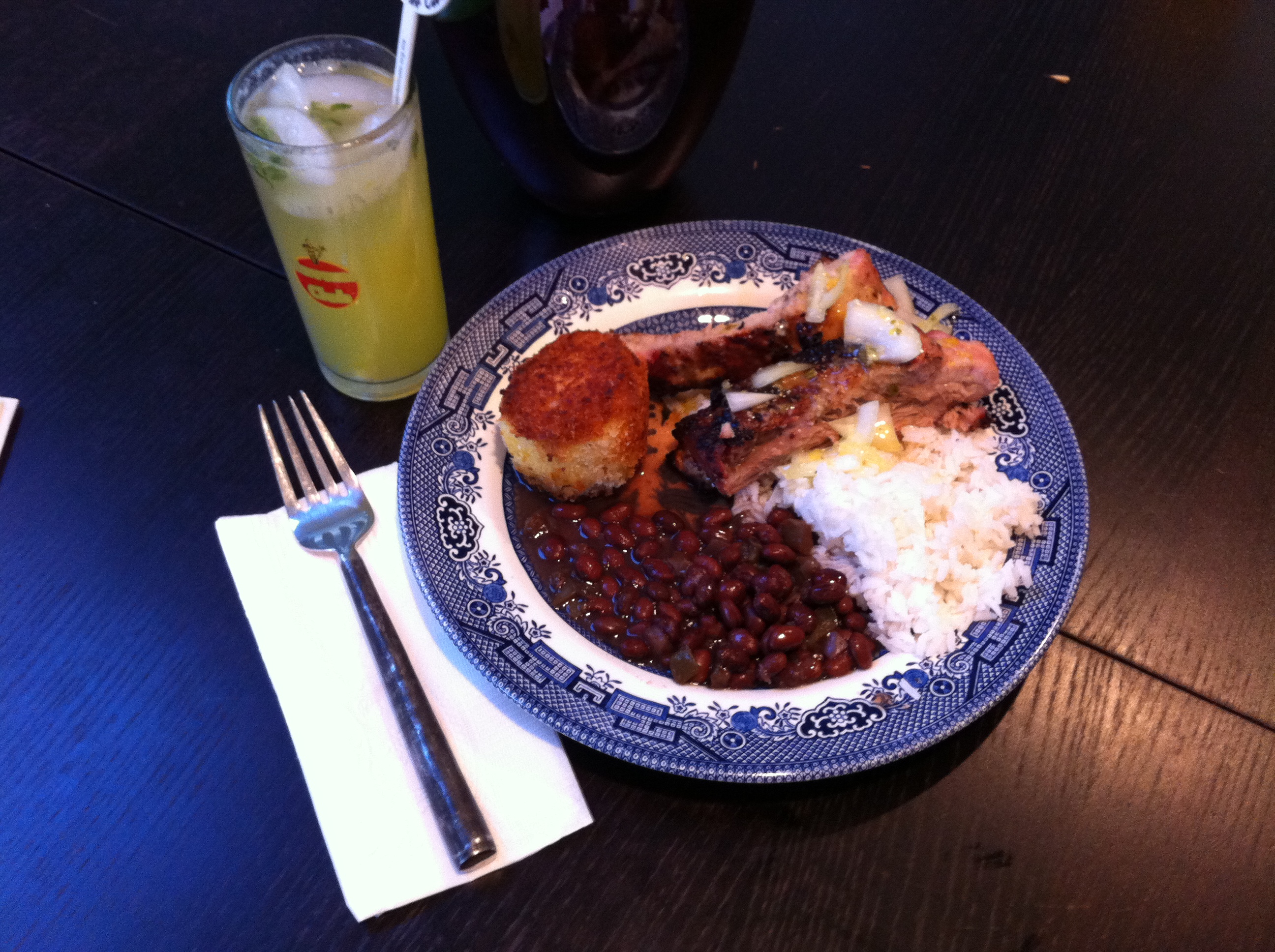
Papas rellenas, costillitas, beans and rice and a mojito.

If you were to go out for dinner in Havana, you would likely wind up in a private home at a “paladar” — restaurants people have set up in their living rooms or on their balconies, serving homecooked food. Your choices are that or a government-run restaurant. (Imagine eating at a government-run restaurant in a U.S. DMV or passport office… you’d be dreaming of Olive Garden or Sizzler…)

I’ve never been to Havana. I’ve contemplated sneaking in… but figured instead I’d just wait and go with everyone else, once the embargo has been lifted and the Disneyfication has begun. But sometimes I put on Buena Vista Social Club, light a Cuban cigar I smuggled in from Mexico, make some firm mojitos and cook up some Cuban food. Costillitas, in particular — Cuban-style ribs on the grill. These may be the best ribs on earth. Better than St. Louis, better than Tuscan arrosto misto, better even than Hawaiian… (I’ll teach you how to make ALL these in due time, my friends…) And papas rellenas, potato puffs stuffed with spiced beef — a dish I first had at a Cuban restaurant in Madrid. And of course, rice and beans.

The following recipes will serve 4-6, making for a nice Havana-style dinner party in your own paladar. Mojitos recipe included!

*   *   *

Costillitas

1 rack baby back ribs
1 cup orange juice
juice of one lime
6 large garlic cloves, mashed
1 onion, sliced lengthwise into slivers
1 tsp oregano
salt & pepper

Remove the sheathy membrane from the back side of the ribs (to do this, slip a flat-head screwdriver between the membrane and the bone, and peel off). Cut the rack into segments of 3-4 ribs each, and salt the ribs well for about an hour.

To “mash” the garlic, you can use a mortar and pestle. Or you can grate the cloves on the fine grate of a cheese grater. Combine the garlic with the juices, the onion and the oregano in a bowl. Set aside 1/3 of the juice mixture for later. Place ribs in a large roasting dish and marinate with citrus/garlic mixture for an hour at room temperature. (Or several hours in the fridge.)

Get your grill good and hot. Then cook the ribs, turning frequently and basting with marinade, for about 40 minutes, or until golden brown. Serve over rice, drizzled with the reserved citrus/garlic mixture and onions, with Cuban-style beans. (Recipe below)

Papas Rellenas

1 large russet potato, peeled and quartered
1/2 lb ground beef
1 small onion, chopped
1 tbsp tomato paste
1 tbsp chopped green olives
2 eggs
panko bread crumbs
vegetable oil for frying
salt & pepper

Boil potatoes until cooked. Cool and mash in a bowl. Separate egg whites from yolks. Add yolks to potatoes with salt and pepper, and blend thoroughly. Meanwhile, cook ground beef in pan with chopped onion, tomato paste, olives and salt and pepper until browned. Remove from heat and cool.

Whip egg whites in a bowl until frothy. To make papas rellenas, scoop a large tablespoon of potato mixture into the palm of your hands and flatten. Place a teaspoon of the beef mixture into the middle of the potato, then close potato around it to form a ball. Dip the ball in the whipped egg whites, and then in panko to coat thoroughly. In a saucepan, heat about 1/4 inch of oil over medium-high heat. Cook the papas rellenas, a few at a time, turning frequently until browned on all sides. Remove and keep warm until all are cooked and ready to serve.

Cuban-style black beans

1 cup dried black beans, soaked overnight
1 bay leaf
1 chopped onion
1 chopped green pepper
salt & pepper

Cover beans in 3 cups of water. Add bay leaf, chopped onion and green pepper. Bring to a boil in a pot, then lower heat and cover. Cook for 2 hours or until tender, adding more water as necessary (beans should be saucy). Once beans are tender, add salt and pepper to taste and serve.

Mojitos
for each drink:

Juice of two limes
2 heaping tablespoons sugar
4 or 5 mint leaves
1 ounce light rum
fizzy water

Combine lime juice and sugar and stir until sugar dissolves. Place in a tall glass with mint leaves, and toggle with a chopstick or back of a knife, bruising leaves to release oils. Add rum and ice, then fill drink with fizzy water. Serve with a stirrer.

I Believe in the Bean

If you’ve read much of this blog, you know that I’m a big fan of beans.

I like all kinds of beans — soupy black beans with garlicky, citrussy Cuban food (that’s the next post, so stay tuned), earthy borlotti beans from Italy (see two posts back), big meaty faba Asturiana beans from Spain, delicate and floral flageolets from France, fermented Chinese black beans, edamame, Mexican pinto beans…

Today I’m writing — or actually talking — about cannellini beans. In the following video, I’ve cooked a pot of these versatile beans, and prepared them four different ways… so you get an idea of how easy they are to make, and how many different things you can do with them. Of these four preparations, I’ve created two in an Italian style, one Spanish and one French. All take no more than a few minutes to make, once you’ve actually cooked the beans. You can even cook a big batch of beans and keep them in the fridge for a week or so, and make different bean dishes on different nights. Enjoy!

Previous Older Entries Next Newer Entries