Spaghetti, 101 (My Fave Five)

Carbonara

Has there ever been a more perfect, versatile food than spaghetti? Layer-upon-layer of flavors emerging from within coiled strands of toothsome semolina goodness… In Italy, spaghetti is ubiquitous, dressed in myriad creative ways far beyond that ol’ American standard of greasy meatballs and heavy tomato sauce obscuring overcooked noodles. In Italy, it’s the noodle they celebrate more than the sauce. As Mario Batali says, the sauce is the “condiment.” Scroll down a bit and you’ll find recipes for five of my favorite “condiments” — easy, wonderful dishes you can make in as little as 10 minutes!

Meanwhile, here’s three of the best tips you’ll ever get about cooking spaghetti (or any pasta, for that matter):  1.) Salt your water generously before you start cooking the pasta. I typically throw in a heaping tablespoon. 2.) ALWAYS save the pasta water you have cooked the spaghetti in. Very rarely should you actually drain the spaghetti — lift it out instead with tongs and drop it in the sauce. You’ll use the water to moderate the sauciness of your pasta. 3.) DO NOT add olive oil to your pasta water. This is a waste of oil and money. The way to keep your pasta from sticking together is to stir it the first couple minutes it’s in the water, and then once or twice while it’s cooking.

I like to cook a half pound of spaghetti — you can feed 2-4 people (or 10-12 yoga students), depending on how hungry they are. So all of the following recipes are based on cooking a half pound. You could double it to serve more, or to have tasty leftovers in the fridge. (I’m a big tasty leftover guy, myself…) Don’t forget, you’ll want to save the pasta water for several of these recipes.

(Note: Because of ingredients such as butter and pork, several of these recipes will NOT be starlet- or skinny-yoga-student friendly. If you are serving a starlet or skinny yoga student, substitute quinoa for the spaghetti, expeller-pressed sunflower oil for the butter and tempeh for the pork.)


Spaghetti with Butter, Pepper and Parmesan

This is the simplest and perhaps most wonderful of all. You can also substitute 1/4 cup good fruity extra virgin olive oil for the butter if you’d like a lighter, more healthy pasta. But remember, don’t be afraid of butter. And the better quality the butter, salt and cheese, the better the final results. I use Italian butter from the same Parma cows that make Parmesan, Maldon salt and aged Parmesan Reggiano.

1/2 lb spaghetti
1/2 stick butter (1/4 cup)
flaky sea salt and pepper
freshly grated good Parmesan Reggiano cheese

Cook pasta to al dente. Drain briefly in a collander (do not rinse!) Return pasta to cooking pot, toss with butter until all butter is melted. Sprinkle with salt and pepper, toss again, and plate. Top with generous amount of grated Parmesan Reggiano and serve. (You could also sprinkle some chopped Italian parsley over the top for a hint of freshness.)

Spaghetti Carbonara

This is the traditional preparation, which is a whole different animal than the gummy cream-based version you’ve come to know at Olive Garden’s all-you-can-eat pasta bar.

1/2 lb spaghetti
3 oz pancetta (or bacon)
2 tbsp olive oil
1/2 cup grated Parmesan Reggiano, plus extra for grating
1 whole egg and one egg yolk
flaky sea salt and pepper

While pasta water is heating, cook pancetta or bacon to crisp in a pan with olive oil, remove to drain on paper towels and reserve fat in the pan. Cook spaghetti to al dente. Remove with tongs to the pan with the pancetta or bacon fat, bringing a couple tablespoons of pasta water with you. Add pancetta or bacon, broken up into pieces, and heat briefly over high heat, stirring. Remove from heat. Add egg and extra egg yolk and 1/2 cup of Parmesan, and toss to mix. Divide among plates and top with more grated Parmesan, salt and freshly ground pepper.

Spaghetti with Sauteed Greens

This starlet-approved crowd pleaser is perfect for those spontaneous after-yoga-class dinner parties.

1/2 lb spaghetti
1 bunch swiss chard, tuscan black kale or beet greens
3 cloves garlic
1/4 cup olive oil plus extra for drizzling
1 tsp crushed red pepper
flaky sea salt and pepper
Parmesan Reggiano

Cook spaghetti to al dente. While spaghetti is cooking, chop your greens roughly into large pieces. Smash garlic cloves with back of a knife, break up and cook over medium heat in olive oil. As garlic begins to turn golden, add crushed red pepper and toss. Add greens and sauté for five minutes, with a dash of salt, until greens are cooked. Drain pasta, adding 1/4 cup of the pasta water to your greens. Add pasta and cook over high heat for about a minute, or until sauce thickens and binds to pasta. Remove from heat and divide among plates.

Spaghetti with Fresh Clams

You could also use the more familiar linguini in this preparation, which will NOT remind you of the version your grandma in Jersey used to make when you were a kid.

1/2 lb spaghetti
1 lb fresh clams in their shell, scrubbed
3 cloves garlic, crushed with the back of a knife
1 small Spanish chorizo (see La Española Meats under “Links” to order)
1/2 cup wine
1/4 cup olive oil
1/4 cup chopped Italian parsley
flaky sea salt and pepper
Parmesan Reggiano

Cook the spaghetti to al dente. While it’s cooking, slice up the chorizo and cook slices in olive oil over medium heat. Break up crushed garlic and add to pan. Add clams and wine, turn heat to medium high and cover. Cook for about 5 minutes, or until all the clams have opened. (Discard any that do not open.) Remove cover and simmer over low heat. When spaghetti is done, transfer from pot to the pan with tongs. Add a little pasta water if needed. Turn heat to high and cook, tossing, for one minute. Remove from heat. Toss in parsley and season to taste with salt and pepper. Plate the pasta, dividing the clams evenly, and top with some freshly grated Parmesan.

Spaghetti with Tomatoes and Sausage

The simplicity of tomato and pork. You could use turkey or chicken Italian sausage for this if you wanted to. Use colored heirloom tomatoes — green zebra, for example, or golden pineapple — for a vibrant, alternate colored sauce.

1/2 lb spaghetti
1 sweet Italian sausage (or hot if you prefer)
1/4 cup olive oil
3 garlic cloves, smashed with the back of a knife
2 very ripe large tomatoes
flaky sea salt
crushed red pepper
Pecorino Romano

Cook spaghetti to al dente. While pasta is cooking, puree tomatoes in a blender. Remove sausage from casing. Heat olive oil in a pan over medium heat, and cook garlic for 1 minute. Add sausage, breaking up with the back of a wooden spoon as it cooks. Once sausage and garlic have begun to turn golden, add tomato puree and season with salt. Cook over medium heat until sauce thickens. When spaghetti is done, transfer from water to sauce pan, and turn heat to high. Cook for a minute or two, tossing, until the pasta is coated. Dish onto plates, sprinkle with a bit of crushed red pepper and salt to taste, and top with grated Pecorino Romano.
Church of the Sacred Table

Preparing a meal is a part of my spiritual practice — kinda like meditation or prayer. I’ve never gotten much sitting in a church, listening to that guy on the pulpit talk. I would slouch in the back, as if it was math class, afraid he was going to he call on me, while he rambled on about sin and salvation.

Sitting in a hard, cold pew on a brilliant Sunday morning was not my idea of inspiration — I never caught a glimpse of God in there. But put me in a kitchen beside vegetables yanked from the earth and a briny fish fresh pulled from the sea, and I’ll get lost in an ecstatic reverie that can only be described as mystical.

What is it about this most basic of activities that is so deeply resonant on so many levels? For one thing, it’s useful. I’ve always admired guys who make chairs — there is nothing more important than a chair, especially one that is well made and comfortable. A meal should be the same — well made and comfortable. And yet, it can also be much more. Like a symphony or a work of art or a great achievement in architecture, it can inspire and make us feel our place in the flow of life more deeply. It can connect us to the world — both what’s right there around us, and what’s far away and exotic. And it is an egalitarian pleasure. A rustic bread baked in a tandoori in a grimy alley in New Delhi is every bit as noble as a duck torte from the Parisian kitchen of Ducasse. A $.50 fish taco from a street corner in Puerto Vallarta can linger in the memory just as long as a whole fried catfish from a seafood palace in Hong Kong.

A plate of homemade food is also the antidote to our fast-food culture. I remember feeling encouraged years ago when the Slow Food movement emerged. Preparing a meal from scratch, even if it’s a simple pasta that only takes 20 minutes, is the opposite of that 20-something guy in the Carl’s Jr. commercial grunting and spilling ketchup all over himself. It’s an act of love and respect, toward yourself and the bounty that has been afforded us. Go to the farmer’s market, buy whatever’s in season — not shipped/trucked in from Chile or New Zealand, but from the guy who grew them a few miles away. Listen to what he has to say about sin and salvation. Clear your afternoon and invite some friends over. Invite the farmer. Invite that guy from the pulpit, if you’d like. Open a bottle of wine. Enjoy every moment of slicing the food, watching it transform in the pan, composing the plate as if you were painting your masterpiece. Revel in watching your friends enjoy what you’ve made. Cooking for only yourself? Leave the Souffer’s or Lean Cuisine to freezer burn and get out a pot and pan. Make yourself a three course dinner — after all, who deserves your love and respect more than yourself?

And then take it to the next level, and try growing some vegetables, keep some chickens and collect eggs if you’ve got room, buy a goat and try making cheese. Get your hands into the earth and see how your food grows. Pick a corn right off the stalk and eat it there, the life still pulsing through it.

I once heard the Vietnamese Buddhist monk, Thich Naht Hahn, tell a long story about sitting on a beach in France peeling an orange. Touching the peel, experiencing the scent, biting into the flesh. “An orange, dear friends,” he said, “is nothing less than a miracle.”

As I write this, I am reminded of what’s so important about cooking to me, which is that it reminds me what life is all about. Passion, love, laughter, sharing, family and friends, kindness, generosity, being absolutely in the moment. All the ingredients of a meal shared together. All the ingredients of a life well lived.

Aioli

Here’s a neat trick. If you wanna get a skinny yoga student or starlet to eat mayonnaise, just call it “aioli.”

Aioli is, in reality, a kind of a mayonnaise. In Southern France, it is made — like mayonnaise — from an emulsion of oil, egg yolk and lemon juice, with a lot of garlic added. Though you will find lime/ginger aiolis and chipotle aiolis and the like at TGIF or Chili’s or Claim Jumper or whatever other fine dining establishments you frequent, a true aioli is simply what I’ve described above. In Spain, they make a version called “alioli” (notice the extra “l”), which is emulsified without the egg — a dandy trick I will now demonstrate for you:

You can mix the alioli with some mayonnaise to make a fantastic dip for artichoke leaves or french fries. It’s also killer on steak sandwiches or on top of freshly grilled fish. But my favorite application is a kind of paella from Spain’s Valencia region called “fideus,” which is made with noodles instead of the traditional rice, and on top of which you plop a big glop of alioli at the end. (You’ll need fish stock for this recipe. It’s really important, so don’t use chicken stock. You’d be better off using a Knorr’s fish bouillon cube, which actually aren’t bad in a pinch. You can buy fish stock at fancy stores, or ask the fish guy for some heads and bones and take them home, throw them in a pot of water, and boil with an onion and salt for about an hour. Then strain.) Here is a recipe that will serve 4 to 6:

Fideus

1 lb. spaghetti, broken into 2-inch pieces
1/4 cup olive oil
1 quart fish stock, plus water as needed
2 large very ripe tomatoes
1 chopped onion
1/2 tsp. saffron
alioli

You’ll need a very large pan for this. A traditional paella pan, around 15 to 20 inches, is preferable — both for cooking and presentation. But any large, flat pan will do. Heat the olive oil over medium heat, and add the spaghetti, tossing until all the noodles are coated and are beginning to toast. Puree the two tomatoes in a blender and add to noodles with the chopped onion. Then add the stock and the saffron.

Cook the fideus over medium/low heat for around 20 minutes, adding water or more stock if the first round cooks away. You may need to turn the pan once or twice if you’re getting hot spots to ensure all the noodles cook evenly. When the noodles appear well cooked and the stock has turned thick and saucy, remove from the stove and place in a very hot pre-heated oven. Broil for a few minutes, until some of the noodles begin to curl and burn at the edges (you can also do this final step in a hot barbecue, which is more traditional — in Spain, paellas are traditionally cooked over open fires).

To serve, either place the entire paella pan in the center of the table (this is very impressive!) and let each guest scoop some onto their plate and top with alioli. In Spain, everyone would just eat right from the paella pan, which you can do if your guests won’t freak out. Or you can plate some fideus for each guest and top with a spoonful of alioli. You’ve got options.

for the alioli:

Four large garlic cloves (or six medium cloves)
1 tsp salt
olive oil
lemon

Place the garlic cloves in the mortar and pestle with the salt. Mash repeatedly until a smooth paste forms. Then begin to drizzle in a little olive oil, continue mashing constantly. When the olive oil is incorporated into the paste, drizzle in a little bit more. Continue until a fine, thick mayonnaise forms. Squeeze a couple drops of lemon juice in at some point — especially if the emulsion seems to be breaking down. You’ll probably add 1/4 to 1/2 cup olive oil in all, and the process should take a good 10 minutes.

The Great Lard Freak Out

I remember the Great Lard Freak Out of the 1980s. People suddenly discovered that flour tortillas were being made with lard! (As they had been for centuries in Mexico, but anyway…) Suddenly lard was the culprit in a world of food ills. Much the same as MSG had been. “Our food made with NO LARD!” signs in Mexican restaurants would proclaim.

I don’t want Mexican food made without lard.

I believe quinoa was the progeny of this period of food freak out. So was margarine, which is one of the most terrible products on earth — and far worse for you than lard. But lard retains its stigma. For skinny girls and starlets/yoga students, it’s the mayonnaise of meat products. There’s a cured Italian meat called “lardo,” but you’ll be hard-pressed to get any but the most adventurous eaters to try it. “Lardo??” your friends will say, “As in ‘LARD’!??”

Man cannot live on lard alone. Certainly if you ate too much of it you’d be courting problems. But that could be said of most foods (quinoa aside). The key to everything is moderation. A little lard in a tamale or tortilla isn’t gonna kill you — it’s gonna likely be better than the shortening used instead, and it’s going to taste a heck of a lot better. It amazes me that people put synthetic non-dairy creamer in their coffee. My cream come from a cow, where does your non-dairy creamer come from? A chemical factory. And you’d rather put THAT in your body?

You should seek out the things that taste good and natural in life, and eat them. When you want something creamy, eat cream. Eat a gelato, not a fat-free Splenda dessert. When you want healthy, eat a carrot. Eat good things in moderation. Stop eating before you are full, learn to be satisfied rather than gorged. If people could learn this in every area of their lives, we wouldn’t have subprime mortgage crises, epidemic obesity or skyrocketing personal bankruptcies. Eat food that is fresh, in season and local — tomatoes will taste better in July, and they won’t bear a brontosaurus-size carbon footprint after their transcontinental trip from Peru.

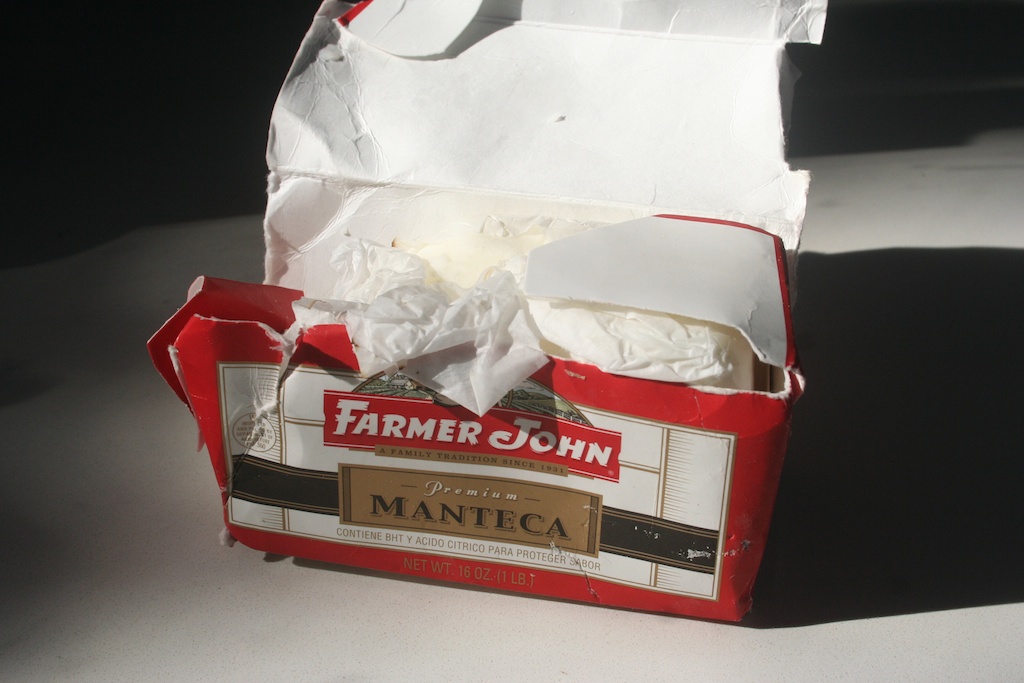
I keep a cube of Farmer John’s lard in my freezer — the kind in the red box you see at the grocery store that says “manteca” on it. It’s been there for a year or so. Every once in a while, when I’m making tamales or certain other dishes, I pull it out and shave a little off into the recipe. It makes the food taste a whole lot better. And it’s not going to kill me as fast as skinny girl’s Country Crock.

Next time you’re in a Mexican restaurant and are contemplating ordering a dish, ask if it has lard in it. If the waiter says yes, you say: “Thank you. That’s what I’ll have!”

A Brief History of Quinoa

From the upcoming Oliver Stone documentary, “The Truth About Quinoa”:

“Horace Tollman, former engineer for the US state department, revealed that quinoa was not actually a grain at all, but a genetically engineered biocrop created in the 1970s in an effort to infiltrate and destroy the Soviet wheat crops. It was never meant to be eaten…”

Okay, not really. Quinoa is not a “true” grain, as it is not the grass family. (Take that, quinoa!) But is more closely related to beets, spinach and tumbleweeds. (Now we’re getting somewhere.) It originated in the Peruvian Andes, and its name translates from the Incan as “Food which is eaten by skinny yoga students”. Quinoa is high in protein (so is pork) and is gluten free. So there you have it.

What to do with it? My friend, Paul, IM’d me one day to tell me he was doing “something with quinoa” for lunch. “Why?” I said. I guess he didn’t want gluten. I’m sure you could find some recipes for it in “Cooking with Shirley Maclaine” or “Ali MacGraw’s Favorite Yoga Creations”. (What is it with these flaky “Mac” women, anyway??)

Actually, seriously folks… I don’t really have anything against quinoa. It just sort of plays as a convenient Falstaff to my hero, pork. And its popularity with the yoga crowd makes it overly ripe for ridicule. In the interest of fairness, here’s a recipe (WARNING to skinny starlets: the following recipe contains butter.):

2 cups cooked quinoa
4 or 5 asparagus, cut diagonally into 2-inch spears
2 cloves garlic, minced or crushed in a press
2 tbsp olive oil
1 tbsp butter
1/4 cup grated parmesan
1/4 cup chopped Italian parsley

Cook the quinoa however you cook quinoa — I’ve never cooked it, so I don’t know how. I guess you probably steam it like rice. In a separate pan, heat the olive oil and gently saute the asparagus for 5 minutes over medium heat. Toss in the quinoa. Remove from heat. Stir in butter until melted, toss in parmesan and serve in bowls sprinkled with Italian parsley, salt and pepper.

Previous Older Entries Next Newer Entries