The Most Expensive Ham in the World

jamón iberico bellota

I’d been reading about the stuff for years. A mythical ham cured for years from the meat of the black-hooved Iberian pig, left alone to wander among the oak woods of Salamanca foraging for acorns — “bellotas” in Spanish.

If you’ve ever been to Spain, you know they’re serious about their ham. One of the most popular restaurants in Madrid is the Museo de Jamón — the “Ham Museum”. And in a country that takes its ham this seriously, iberico bellota is king. For years if you wanted some, you would have to travel to Spain. Only recently was it cleared for export to the United States, with our stringent regulations against the importing of long-fermented, unpasteurized things.

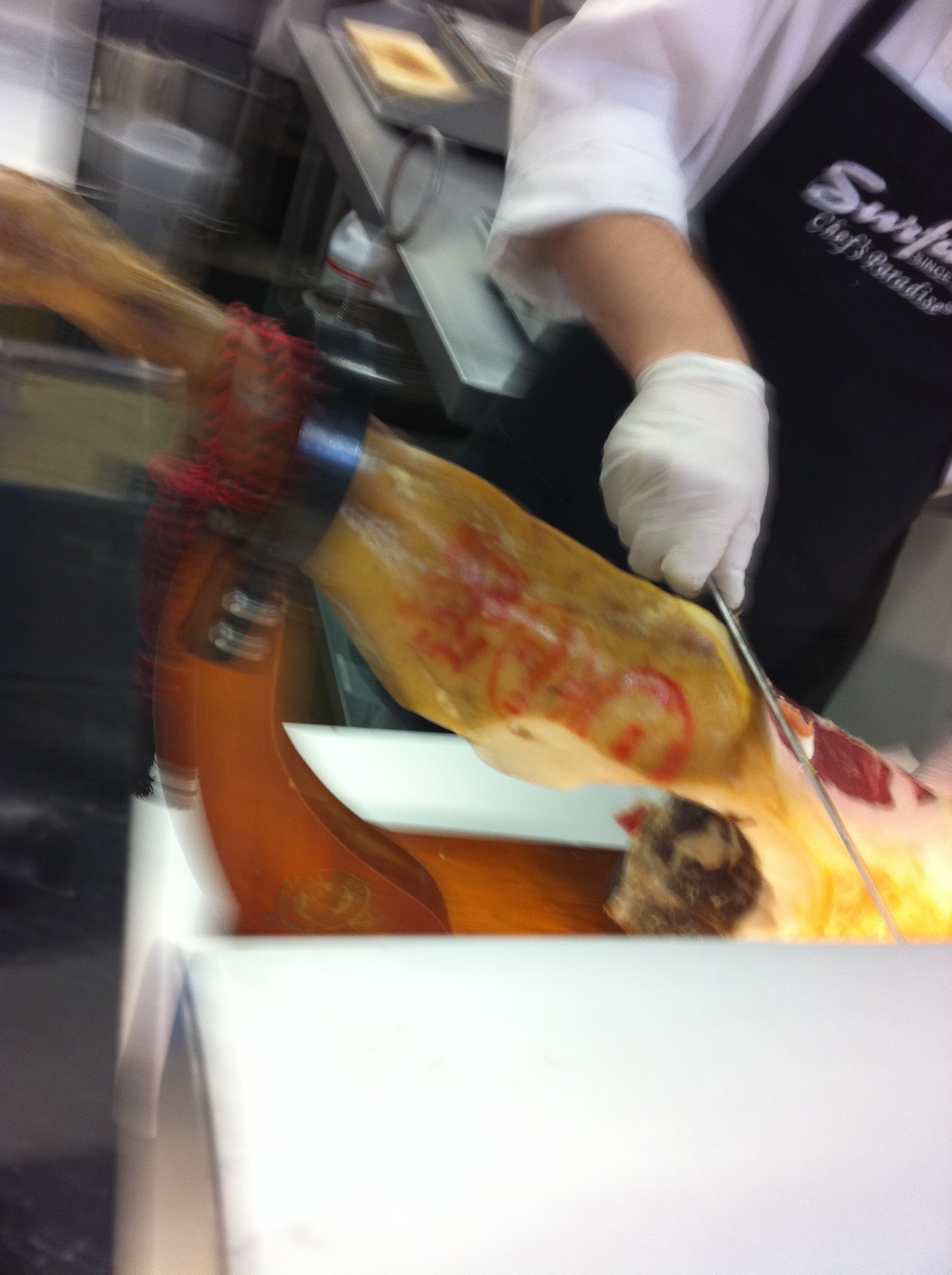
Guy carving iberico bellota

Iberico bellota is one of the best things I’ve ever put in my mouth. It will make you forget that proscuitto de Parma you used to think was so good. I love to watch the guy carving slices from the whole ham in the traditional manner (it is never sliced on a machine like proscuitto, so it always has a rustic, thicker quality). The meat explodes on your tongue in layers of flavor — nutty and dense, elegant and briny — and the fat is unctuous and silky. I must stop talking about it now or I’m going to have to excuse myself…

It is, indeed, the most expensive ham in the world — I pay $135 a pound for it, and am grateful for the privilege. I don’t buy it often, and usually get a quarter pound for $35. It’s plenty. You might have trouble finding this stuff. If I were you, I would make like a detective and do whatever you had to do to pick up its trail. If you live in L.A., I get mine at Surfa’s in Culver City. You could likely get it at the Spanish Table in Seattle (I know there’s a few of you out there). Probably Dean & DeLuca’s or someplace like that in NYC. You could buy a whole one online from tienda.com for $1,400. (Let me know… I might go in on it with you.)

A recipe?

Buy some iberico bellota. And eat it. Serves 1. (You won’t want to share.)

If you have to do something to it, get the best crusty loaf of bread you can buy, get the best butter you can buy… tear off a piece, spread a little butter, top with iberico bellota, and sprinkle with a little Maldon salt.

In heaven, iberico bellota will grow on trees like figs.

That Fish in the Fridge

My German friend, Pirco, called me one evening.

“Sean,” he said, “I have a piece of fish. What do I do with it?”

I needed more information. What kind of fish, for example, was it?

“I don’t know. It’s sort of white.”

“Is it a fillet or a steak?” I asked.

“It’s a rectangle.”

I gave Pirco my advice on what to do with his rectangle. The video above and recipe below show you what to do with your own rectangle of fish. But first, a few words on fish in general.

Fish is one of the easiest foods to cook beautifully. It is also one of the easiest to screw up. I was giving a cooking class recently on fish, and my students were stuck in the salmon rut, and at a loss as to what to do other than throw their fillet on the grill. (i.e. “Do we marinate it in soy sauce?”) If you’ve got very fresh fish, you’ll want to do very little to it. If you’ve got not so fresh fish, you’ll want to sauce it into oblivion. In general, heat is your friend. With a few exceptions, you’ll want to cook your fish at very high heat very quickly — in a hot pan, in a hot oven, or on a hot grill. And you might experiment with some different types of fish. Branzino, black cod, halibut, Atlantic cod and John Dory are some of my favorites. Talk to the fish guy, tell him what you like.

And now, here’s your recipe:

Serves two.

Sauteed Whitefish

2 half pound fillets of whitefish (red snapper, halibut, black cod, mahi mahi, etc.)
flour
3 tbsp olive oil
2 tbsp butter (not Country Crock or I-Can’t-Believe-It’s-Not-Butter)
juice of one lemon (or 1/4 cup white wine)

Dust each fillet with flour to cover. Heat olive oil over medium high heat in a large pan. Fry the fish for about 3 minutes, until it begins to brown, and then flip. Add more olive oil if the pan seems dry. Cook for an additional 3 minutes on second side. (If fish is very thick, give it an extra minute on each side.) Remove fish from pan to a plate and keep warm in a pre-heated 200 degree oven.

Deglaze the pan — add juice of one lemon (or 1/4 cup of white wine) to pan and immediately remove pan from heat. Using a spatula, scrape up any bits of flour sticking to the pan into the sauce. Add your two tbsp of butter and stir constantly, until your pan juices and butter have emulsified into a velvety sauce. Plate fish, and drizzle sauce over the top.

(In the video above, I have sauteed some chopped swiss chard in olive oil and sea salt. I steamed arborio rice and when it was cooked, tossed in a tbsp of butter, 1/4 cup chopped Italian parsley and 1/4 cup grated parmesan reggiano. To plate, I placed some chard at the bottom of the plate, topped with the rice in a food mold [you could simply scoop some rice on top artfully], topped that with the fish, then drizzled the sauce around, and added some balsamic reduction for flair. Please note: I accidentally said “salmon” in the video, but the fish I was preparing was actually halibut. If I was a Food Network superstar, I’d re-edit that segment.)

Wine suggestion: A light, French-style chardonnay (not one of those clumsy over-oaked Napa monsters)

Wining & Dining 101

“I will drink no wine before it’s time.” —Orson Welles

Well, that didn’t exactly end well, did it…

BTW, Skinny Girls & Mayonnaise can now be followed on Twitter at skinnygirlsmayo — cooking tips, humorous asides, farmer’s market reports, fab ingredients, various little surprises, stealth restaurant reviews… and absolutely no taco trucks whatsoever.

Here’s a fun little quiz before we begin. Answer correctly, and you’ll make me feel better about my own drinking habits.  : )

In Europe, it’s normal to drink with lunch. In America, unless there’s football on, people look at you funny if you drink during the day. Of course, eating a 1,200 calorie hamburger is somehow better…

The object is not to get drunk. It is to enjoy a finely crafted, fermented beverage. Budweiser and Sutter Home wines do not count.

Since well before Christ performed his most famous party trick and turned water into wine, men have been fermenting liquids and enjoying the frivolity that ensued. But drinking wine, beer or other libations with food can be serious business.

Having a family wine business, I’m often asked what wines and drinks go well with what foods. I answer that zinfandel goes well with everything. (That’s the only wine we make!) It’s really a matter of taste. But you do want to choose to drink something that complements your food, or to flip that — choose food that makes your wine taste better. I once had a gooey, stinky French cheese that made the zinfandel we were drinking unfold like a symphony in our mouths. That’s an experience you want.

I try to remember to include wine suggestions with most of my recipes. But here’s some very basic thoughts on food/wine/beverage pairings:

Cheese:
I almost hate to give recommendations with cheese, because this is one of the funnest areas to experiment and find your own favorite pairings. Stronger cheeses like cambembert or La Tur will bring out the characteristics of large, bold red wines. More subtle cheeses — aged parmesan, asagio, brie, gruyere — often pair nicely with white wines. Try farmstead cheeses from England, Ireland, California or Vermont with a malty beer. My mom swears that coffee and cheddar is one of the world’s greatest combinations. Never tried it myself…

Tomato/Meat pastas:
Medium bodied red wines (zinfandel, sangiovese, syrah). Possibly chardonnay.

Lighter pastas:
A refreshing white such as viogner or pinot grigio, or a light red — gamay or a pinot noir. A light lager beer would work well, too.

Fish:
Depends somewhat on sauce, but you’ll usually be okay with a dry white like sauvignon blanc or a French chardonnay. The exception is if it’s an Asian-style fish with a citrus or vinegar sauce. Then you’ll want something sweet like a good saké or a reisling/gewurtraminer. With fried fish, I would recommend a hoppy beer such as Anchor Steam.

Poultry
Depends on the poultry and the preparation. But in general, with chicken or duck, you want a lighter red, white or rosé. If you’re a fois gras eater, one of the world’s great pairings is fois gras with a sweet sauternes from France — the sweetness beautifully cuts the fatty richness of the liver. Lager beers and Trappist-style ales go well with chicken, especially if its fried.

Pork
Ah, pork… be still my beating heart. There may be nothing better than a warm summer evening, a sweet, smoky rack of ribs cooked on the grill, and a big blackberry-filled zinfandel. In general, pork will benefit from medium-bodied reds, such as pinot noir, Spanish tempranillo or sangiovese. A good sauvignon blanc will work well with lighter dishes, such as proscuitto and melon. Crisp, slightly sweet whites like a Central Coast viognier would do well with barbecue or pork chops. And for a BLT, drink Sierra Nevada Pale Ale.

Steak/Hamburgers:
Go for size and flavor here. Obviously cabernet sauvignon or petite syrah. Also good is a big, fruity zinfandel — especially with burgers. Big Italian barolos would pair nicely with steak, too.

Salads:
This is one of the trickier pairings, especially when you’ve got a lot of acidity in the dressing. Softer, less acidic whites tend to do well — a buttery chardonnay, a reisling or a French Pouilly-Fumé.

Chocolate/dessert:
Chocolate and port is one of the world’s great pairings. In general, you’ll want a sweet wine with your dessert. There are many good late-harvest wines being made domestically which bring a lovely finish to your meal.

If you have specific pairing questions, leave a comment with your question and I’ll do my best to answer it.

Building a Better Burger

Each year, as summer fades to fall, I reflect upon a season of dreadful hamburgers I’ve been served at parties and barbecues over the previous three months.

It’s not that hard to make a great hamburger. So why do so many people screw them up. Several reasons, the top two of which are:

• Too long on the grill/overcooked hockey puck burger
• Non-creative condiments (ketchup, mustard, tomato slices, iceberg lettuce leaves)

Overgrilling is the most frequent problem. And not just with burgers — you’ve been the sad recipient, I’m sure, of leathery chicken breasts or chalky soy-marinated mega-fillets of salmon fresh off their hour on the barbie. The grill should be as hot as you can get it, the burgers at least 1/2 inch thick and well seasoned with salt and pepper. Grill them until brown and a little charred on each side. Touch them with your finger, they should still have a little give — more if you like them medium rare. A burger should never be cooked beyond medium.

Non-creative condiments run a close second. First, pick a good, soft bun or crusty bread. Then think about what you can put on the burger beyond ketchup and mustard. In the video, I use a mixture of BBQ sauce and a little mayo. I cook bacon, and then caramelize onions in the bacon pan with a little rice wine vinegar, ketchup and Worcestershire sauce thrown in at the end. I crumble some bleu cheese on top, and then add some arugula. That simple, and people often say, “That’s the best burger I’ve had!” Here’s some other interesting condiment combinations you could try:

Hawaiian
Grilled pineapple
teriyaki sauce
Maui onion
served on King’s Hawaiian Bread rolls

Kobe-style
Wasabi mayo (wasabi paste mixed with mayonnaise)
julienned green onions
red oak leaf lettuce
served on thickly sliced brioche

Provence
Brie
cornichon pickles
Dijon mustard
frisee lettuce
served on a soft baguette

Tuscany
Proscuitto
shaved parmesan reggiano
salt-cured black olives
arugula
served on a doughy, crusty ciabatta

In & Out Copycat
make two thinner patties for each burger
American cheese slices, cooked on burgers
chopped onion, pan-grilled in a little oil
Thousand Island dressing
ripe tomato slices
iceberg lettuce leaves
served on sesame seed buns

Just in case the above video left you wanting more, here’s the “Immy Cam” outtakes — me and friends talking about the pros and cons of Twitter, my friend Alex holding my new daughter Imogen:

A Little Trek to Little Saigon

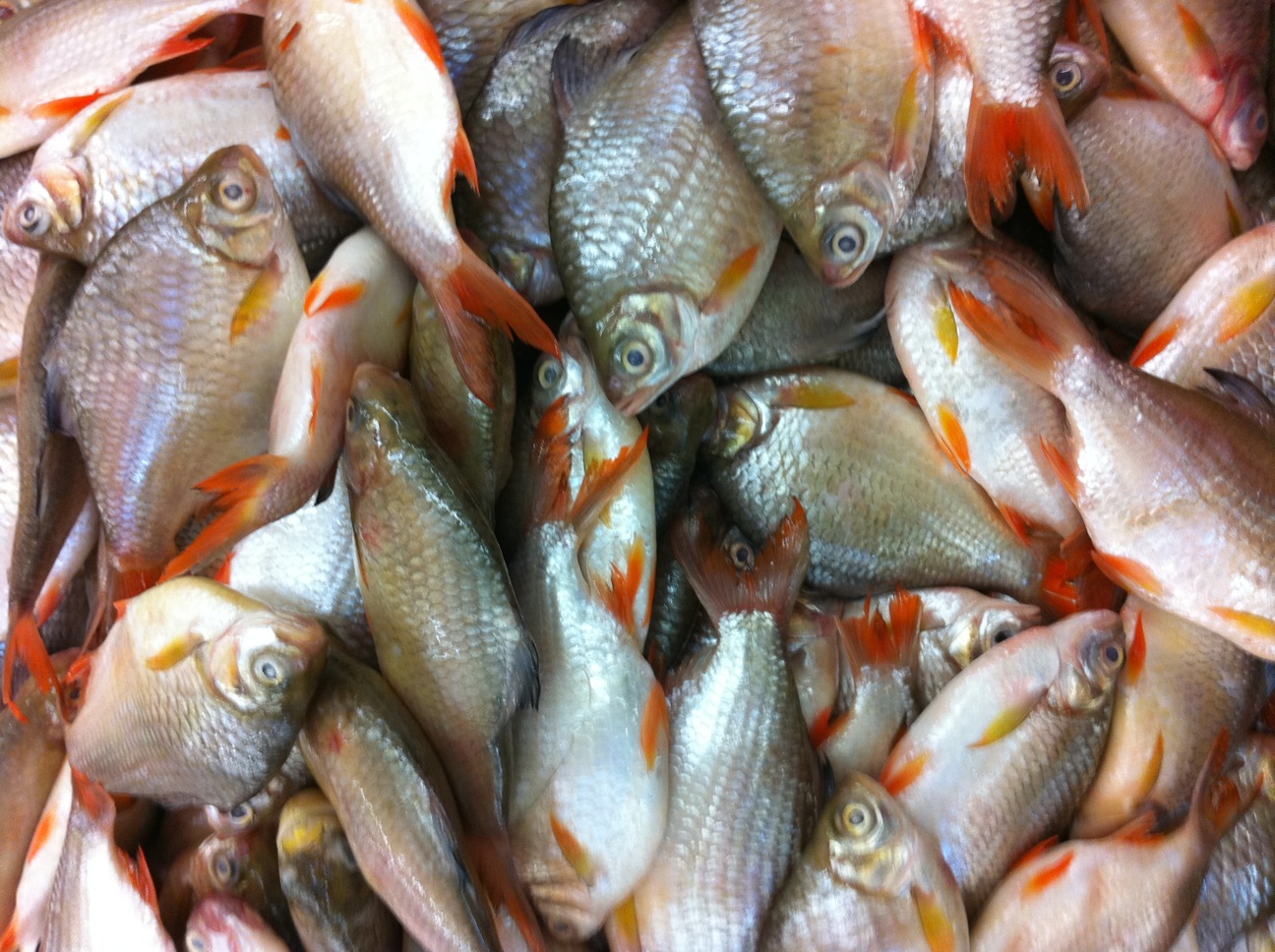
Fish at the ABC Market in Little Saigon

When friends invited us to spend a few days at a beach house in Seal Beach, my imagination immediately went east. Across the 405, into the lovely city of Westminster… to the markets of Little Saigon.

If you’ve not been to Little Saigon, you’re missing a fascinating window into the culture of Vietnam. If you haven’t eaten much Vietnamese food, you don’t know what you’ve been missing. I’ll include a couple recipes later in this post. But be warned — you’ll have trouble finding shredded green papaya, fermented fish sauce and sugar cane at the Vons. So you may need to make an afternoon adventure of it. And if you don’t live in Los Angeles, well… you can dream. (Or improvise.)

The dreaded durian

Little Saigon is in Orange County, east of Huntington Beach. If you’re on the 405, get off at Golden West, find Bolsa Ave., and head east. Soon you’ll begin seeing pagoda roofs, Pho restaurants and businesses owned by people named Nguyen. Speaking of those Pho (beef noodle soup) restaurants — or any other kind of Vietnamese restaurant — if it’s lunchtime and you’re hungry, pick one and stop in. I have no specific recommendations — I’ve randomly patronized several of them and they’re all good. But it is the markets, first and foremost, that I go for.

As you head east on Bolsa, the first market you’ll come to on the right is the ABC Market. A little further along, just past Magnolia in an alley to the left, is the A Dong Market, another good one. These places are bigger than Ralphs and filled with things you’ve likely never seen — stinky durian fruits, preserved duck eggs, live eels, dried creatures of every kind, black-skinned chickens. Vietnamese people crowd the fish bins and yell out orders to the white-frocked guys at the offal counter. It’s as close as a vacation to Southeast Asia as you’ll come. Stroll up and down the aisles and you’ll be in awe of the variety. I come here to get things I will use for making French or Italian dishes — ducks, frozen soft shell crabs, beef short ribs, whole raw anchovies. The prices are great. And I come for things I could only imagine using for Vietnamese food — that green papaya and fermented fish sauce I mentioned, for example. I also get Chinese goods like dilluted red vinegar, chili oil and XO sauce. And, in a nod to Vietnam’s French Indochine days, you’ll even find pretty darn good baguettes and croissants.

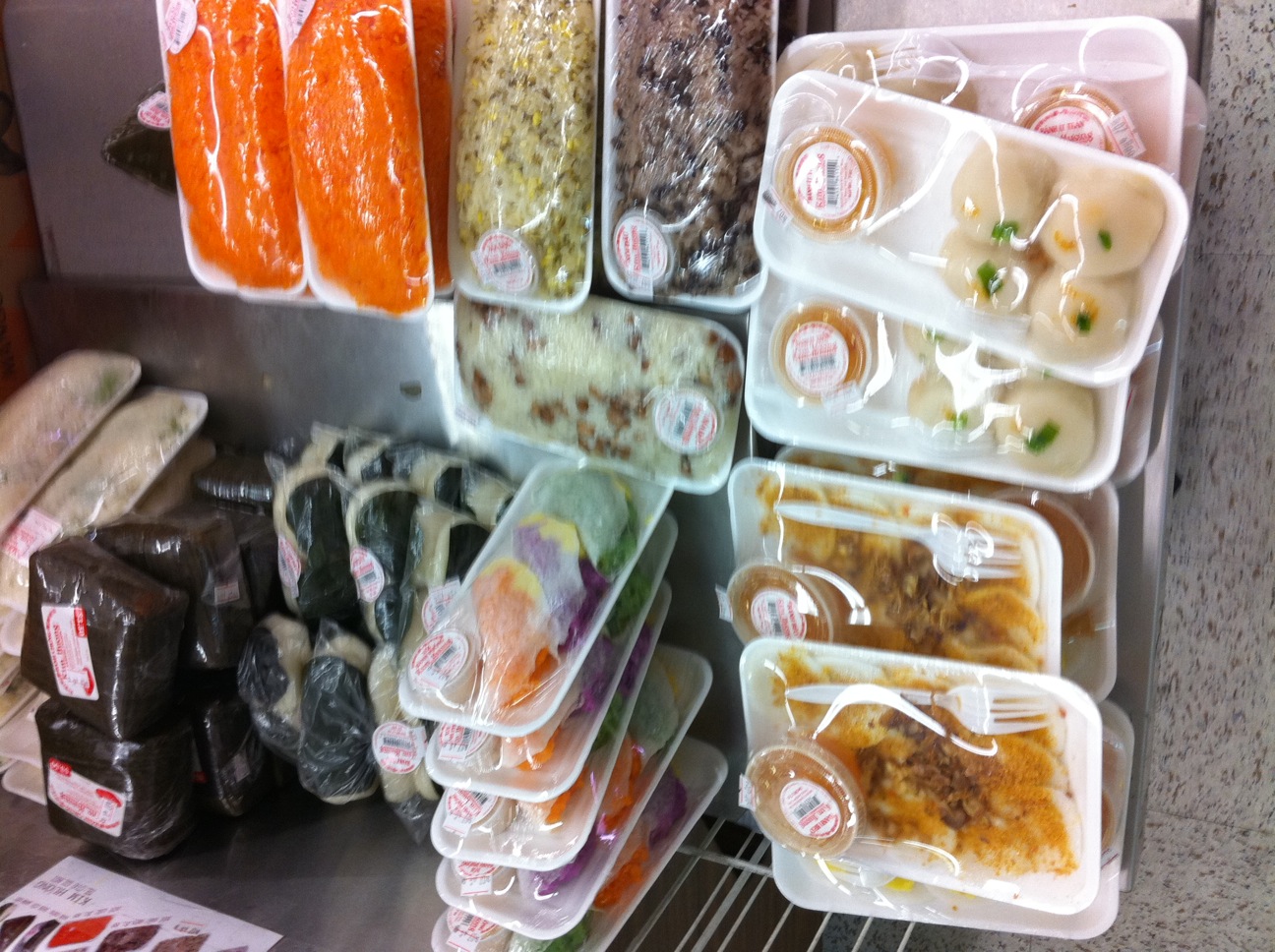
Delicious packaged things

Vietnamese cuisine is one of the most lovely of all Southeast Asia. Lighter and less sugary than the more familiar Thai cooking, less salty and fermented than Korean, its most resonant characteristic is the bounty of flavorful “condiments” served with each dish — fragrant mint and basil leaves, crunchy batons of cucumber, pickled garlic and chopped peanuts. And their cloudlike rice wrappers — which you’ve likely begun to see being wrapped around miscellaneous things at Gelson’s or Whole Foods. (Containing no fat or gluten, they’re highly yoga-student friendly.) Following are two of the best (in my humble opinion) pillars of many a Vietnamese menu. Again, these require a few unusual ingredients and a bit of focus. But the results are well worth your effort. And you didn’t have any plans this Saturday anyway, did you…

Green Papaya Salad
Serves 4
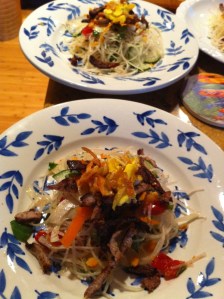
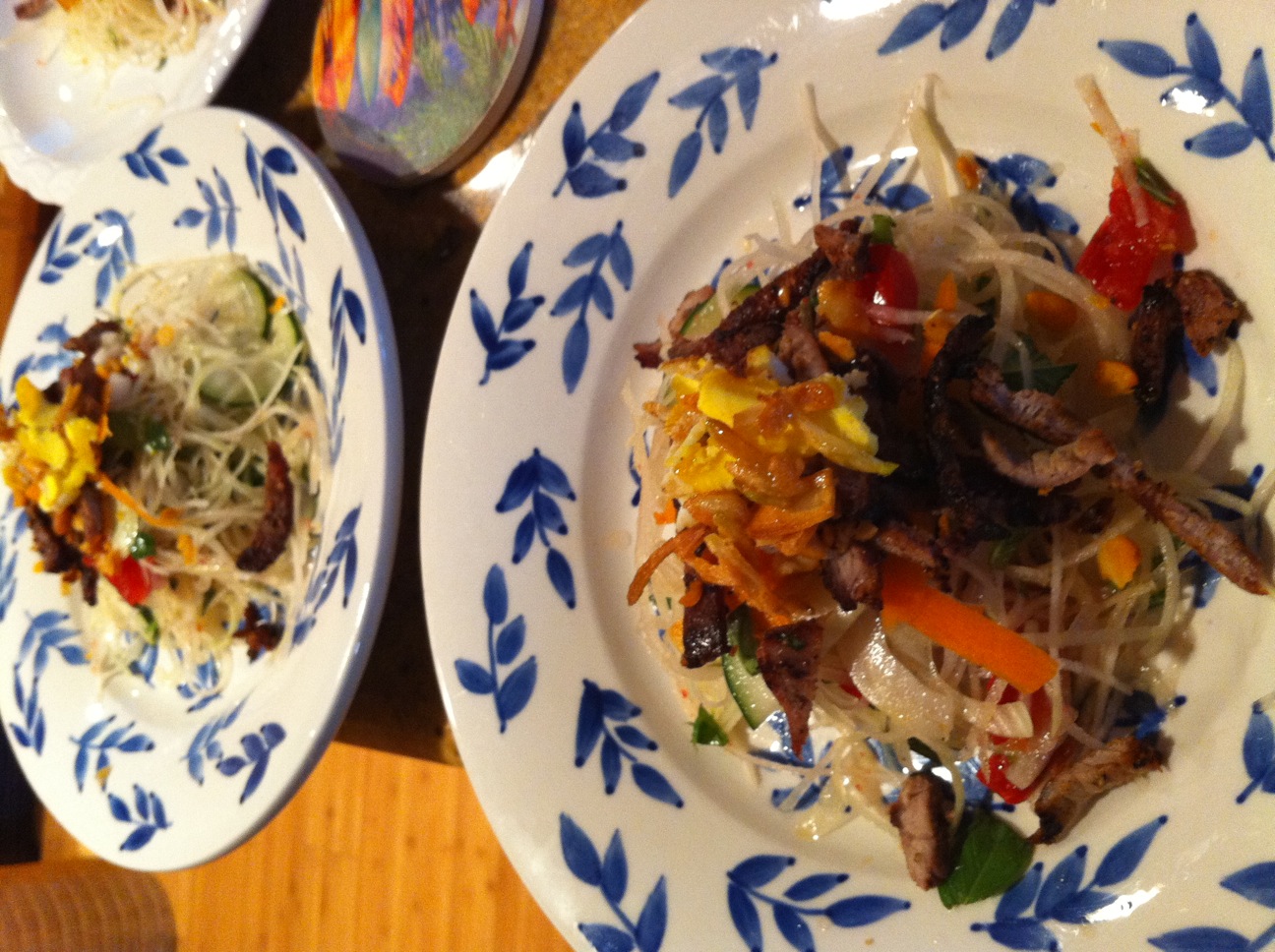
Green papaya salad

1/2 lb shredded green papaya (available in the produce section at the above two markets)
1/2 lb New York steak, cut into slices
1 clove garlic, finely grated
olive oil
1 tomato, cut in eighths
1 small cucumber, cut in 1/4 inch slices then in half
1/2 small onion, cut in half and thinly sliced lengthwise into slivers
2 tbsp basil leaves
2 tbsp mint leaves
1/4 cup thinly sliced or grated carrot
1/4 cup chopped peanuts

Nuac Cham Dressing:
Juice 3 limes
3 tbsp fish sauce (nuac mam in Vietnamese)
1/4 cup water
3 tbsp sugar
1 clove garlic, finely grated
1/4 tsp crushed red pepper

Make the dressing. Combine the lime juice, water and fish sauce, and stir in sugar, whisking vigorously until it has dissolved. Add garlic and red pepper, stir and set aside.

For the salad, slice your steak into thin slices. Mix with a drizzle of olive oil, the grated garlic, a dash of sea salt and freshly ground pepper. Let marinate for 10 minutes, then cook on a very hot grill for about 3 minutes on a side, until browned. Remove and slice into thin strips.

Toss the papaya with sliced cucumber and tomato and herbs. Pour in about 2/3 of your dressing (save a third for dipping sauce for your shrimp dish, below, if you are making it). Add a good drizzle of olive oil and toss. Divide between four plates. Top each salad with strips of beef, some shreds of carrot for color, and a sprinkling of chopped peanuts. (I’ve also chopped up a well-fried egg in the pics above.)

(Note: you could make this salad with finely chopped napa cabbage if you couldn’t get the green papaya.)


Shrimp on Sugar Cane
Serves 4
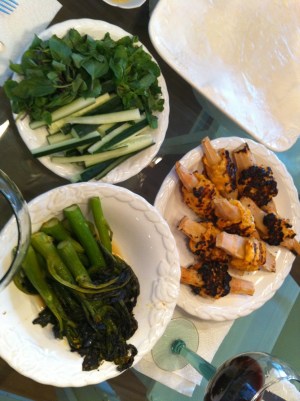
(l to r) rice papers, condiments, shrimp on sugar cane, braised chinese broccoli

1/2 lb peeled and deveined shrimp
1 garlic clove
1 egg
salt and pepper
4 sugar cane, 4-6 inches long, cut in half lengthwise (find canned at Asian markets)
8 dried rice papers
8 small romaine lettuce leaves
1 bunch mint leaves
1 bunch basil leaves
1 small cucumber, cut into batons
1 cup cooked bean thread noodles
1/4 cup chopped peanuts
2 tbsp nuoc cham (recipe above) for dipping

Making sure there is no shell left on your shrimp, puree in a food processor with the egg, garlic and sprinklings of salt and pepper. (A blender will also work, although you’ll need to turn off and stir a few times to make sure your shrimp is thoroughly pureed.) Wet your hands, and form a small patty of shrimp around each half of sugar cane. (Sort of like a shrimp popsicle.) Place on a large plate or platter. Heat BBQ grill to high, and cook the shrimp popsicles about 4 minutes on each side, or until they begin to brown. (Make sure all the shrimp is cooked before you remove.)

Cook the bean thread noodles. Heat some water in a small pot to high. Toss in a small bundle of bean thread noodles (they come in individual dried bundles). Turn off heat and let noodles sit for a few minutes, stirring once or twice, until they are soft. Drain.

Set your condiments out on a large plate or two, as in the picture above — the romaine leaves, the herbs, the cucumber batons, the bean thread noodles and the peanuts. Place the nuoc cham in a small dipping bowl. Rehydrate the rice papers by running them briefly under warm water. Lay out on a large platter, making sure they don’t overlap much or they will stick together. (Alternately, you can rehydrate them one or two at a time, as needed.) Lay out shrimp popsicles on another plate.

Each diner assembles his or her own rolls. Take a rice paper, place a lettuce leaf near the center, take shrimp meat off of one sugar cane and place on lettuce leaf. Top with condiments as desired — a few noodles, some mint and basil leaves, a couple cucumber batons, some peanuts… and then roll up like a burrito. Dip into nuoc cham and enjoy with a cold beer! (Singha is my choice with this meal.)

Previous Older Entries Next Newer Entries