Getting Crudo

Love raw fish but getting tired of soy sauce? The Italian equivalent of sashimi — called “crudo,” which means “raw”— is a perfect alternative.
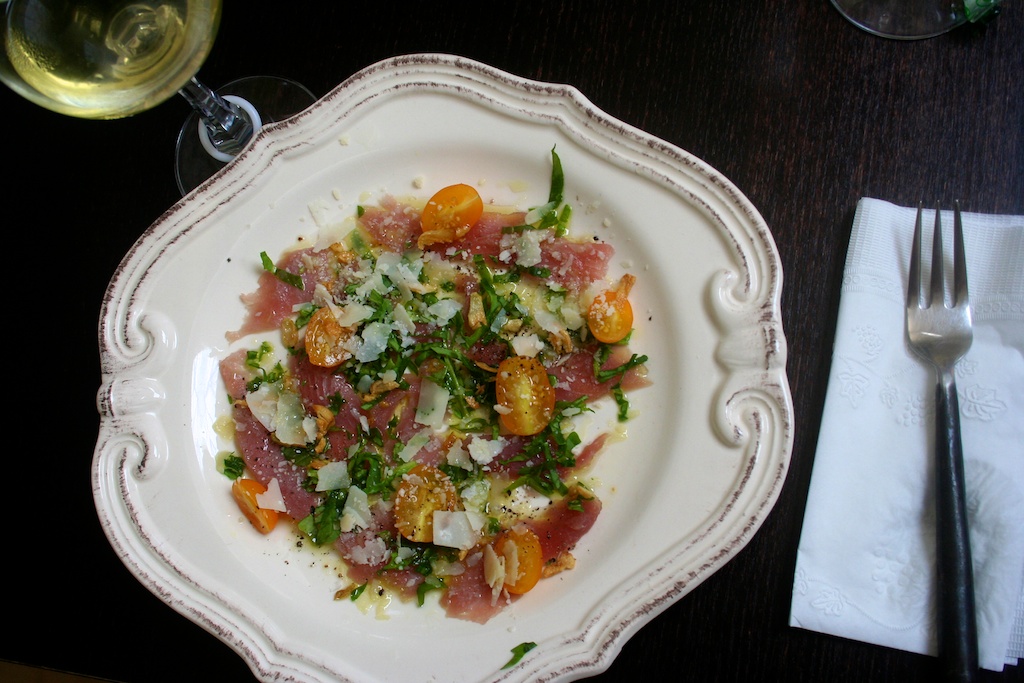
Crudo comes in as many variations as there are Italian restaurants. A dish of crudo rests on three pillars — sashimi-grade fish, a tangy dressing of either lemon juice or balsamic vinegar, and the best olive oil you’ve got. Then you add various “decorations” like minced arugula, shaved parmesan, etc. As you can see from the above photo, it’s also a knock-out to serve to a date or at a small dinner party, as its beauty knows no limits.

I’ve found the best fish to use to be albacore, ahi tuna, halibut or scallops. Yellowtail works nicely too. However, it would be a nice way to serve raw oysters or clams. Or substitute shaved raw beef for a lovely carpaccio.

The following recipe tells you how to make exactly what’s in the picture above. You can do your own riffs — I sometimes add thin slices of grapefruit, dollops of pureed fava bean, whatever is good and in season and that complements the sweetness of the fish, sourness of the citrus (or vinegar) and silkiness of the olive oil. For an artistic flourish, add a drizzle of ebony kecap manis — your friends will forgive you its Indonesian origins for its indescribable sweet, anise goodness. (And when they ask what that sweet black stuff is, just shrug and say, “Dunno.”)

Albacore Crudo

To serve 4-6:

1/2 lb albacore, sashimi-grade
12-15 ripe cherry tomatoes, cut in half
extra virgin olive oil
meyer lemon
1/4 cup arugula, cut into chiffonade (little, long strips)
1/4 cup shaved parmasan
3 garlic cloves, thinly sliced
Maldon sea salt
freshly ground pepper

Place the sliced garlic in a little pan with enough olive oil just to cover. Head over medium until garlic begins to sizzle, and turn to low. Cook, stirring occasionally, until garlic is crisp and golden. Remove and drain on paper towel.

Arrange your serving plates. (Note: for a “communal” crudo experience, you can use one large platter, and guests can all spoon bites from the platter. This is a very dramatic and beautiful way to serve it if you have a large, beautiful platter.) Make sure albacore is very cold (it helps to put it in the freezer for 20 minutes before you begin). Slice it thinly, and arrange slices in random patterns evenly over your plates. Place cherry tomato halves artfully around the fish. Sprinkle arugula chiffonade over each plate. Squeeze a little lemon over each, then drizzle with a generous drizzle of olive oil. Sprinkle shaved parmesan over each plate, then a little Maldon salt (or kosher salt, if you ain’t got Maldon). Lastly, top with a twist of black pepper, and then sprinkle a little crispy garlic over each crudo.

Wine suggestion: a crisp pinot grigio or sauvignon blanc

Mise en place

This is one of the most important tips I will ever share with you, so pay close attention.

One of the greatest challenges for the home cook is having all your ingredients ready on time, all your dishes composed and ready to serve hot (or cold), especially if you’re doing a dinner party. But the professional restaurant kitchen has a secret — the mise en place.

Borrowed from the French, mise en place translates as “everything in place.” It’s what you’ll want to do before you begin. Anything you can make beforehand, do. If your recipe calls for chopped onions, have them chopped and waiting in a bowl well before you begin. If you’re sprinkling a bit of minced parsley over a pasta dish at the last minute, have the parsley ready. Otherwise, your food will get cold.

The above photo is a portion of the mise en place for my annual New Year’s Eve dinner, in which I do 8-12 courses for 8-12 people. Other than serving and volunteer sous chefs, I have no help. But I am preparing for several days before the event. I make stocks and reductions days before, I spend the day of chopping and cutting ingredients, pre-cooking any vegetables I can, setting everything up. In the photo above, you can see four different little bowls of flower petals I picked that morning, which I sprinkled over different dishes for color just before serving.

It’s a little thing. It makes a big difference. Next time you have friends for dinner, experiment with mise en place. See how much of your dinner you can make before your friends even come. Once people are there it should be about composing more than cooking. You’ll have more fun, and you’ll have more time with your friends.

Pepper, Proper

I don’t want to see one of those little rectangular boxes of pre-ground pepper in your kitchen. I’m serious — if I see it, I will throw it away.

When I’m cooking in someone else’s kitchen or giving a cooking lesson in a home, I’m often amazed at the supplies people have on hand. Or lack of supplies, I should say. I ask for garlic, and they pull out a jar of pre-crushed garlic from the fridge. I ask for salt, I get the girl with the umbrella. In cooking, the simplest things are the most important. I will tell you what you need to have, it is your job to get it.

Pepper is one such item. Please, please NEVER use the pre-ground pepper in the rectangular metal container. Get yourself a pepper mill — I like the tall wooden ones they have at restaurants — buy whole peppercorns (they can be expensive, but you’ll find affordable and decent peppercorns at Mexican or Persian markets), and grind as you need. Grind into recipes, grind over finished dishes. Grind, grind, grind with abandon. But I beg of you, just don’t shake.

Summer’s glorious gazpacho

On a hot summer afternoon in Spain — and if you’ve not experienced a hot summer afternoon in Spain, you don’t know heat — nothing is as refreshing as a bowl of chilled gazpacho.

This is one of the world’s easiest dishes to make. I served it a couple nights ago, and when I told our friend how to make it, she said, “You’re kidding?” With the bounty of gorgeous heirloom tomatoes available at the farmer’s markets and upscale stores during the summer, you can go crazy with variety — a sweet golden gazpacho made with sun gold cherry tomatoes, a lusty maroon gazpacho made with cherokee purple tomatoes, even a green gazpacho made with green zebra tomatoes.

This recipe serves six as a first course, four as a light dinner with bread and cheese. I would recommend a fruity rosé for wine.

Gazpacho

1 lb very ripe tomatoes
2 cups water
3 thick slices crusty bread (ciabatta or slipper bread, not sourdough)
3 cloves garlic, crushed
1/4 cup seasoned rice wine vinegar
extra virgin olive oil
sea salt and pepper

Put one slice of bread in a blender. Add water and vinegar. Cut other two slices into cubes, toss with a little olive oil and salt, and toast in a 250-degree oven for about 20-30 minutes, or until golden and hard.

Add tomatoes, garlic, 1/4 cup olive oil and a good pinch of sea salt to the blender and blend on high until a smooth puree. Taste and adjust seasoning if it needs more salt. Place blender in fridge to cool soup for an hour or two.

To serve: reblend briefly, then pour soup into bowls. Drizzle a little olive oil over each soup, top with croutons and a twist of the pepper mill, and serve.

Things You Would Never Consider Putting In Your Mouth (and Why You Should) Pt. I

Your ancestors put some pretty gnarly things in their mouths. People in different places at different times have eaten what they had to in order to stay alive. People in some places eat sea cucumbers.

You’ve probably put some pretty gnarly things in your own mouth when you think about it. The same people who wince at the idea of eating an oyster will happily shove the leg of a chicken in their mouth; those who gag at the thought of eating a fried grasshopper will eagerly gobble down a fried shrimp, which is basically the grasshopper of the sea. I guess it’s all about what you’re used to.

I’m going to do a series about things you would likely not consider putting in your mouth, and tell you why you should. I’m not going to suggest anything dangerous or overly slimy. This is not an extreme-eating blog. (Once many years ago, when I first got into hunting wild fungi, I found a particular mushroom with a coating of slime on it. It was large and meaty, though, and I wondered if it was edible. I consulted my books, and found out it was — although the description in one book said, “Edible, though hardly incredible.” The mushroom is called the Hideous Gomphideous. As I was preparing it in the kitchen of my mother’s home in Sonoma, California, mom came by and asked me what kind of mushroom it was. I told her, and she said, “I am NOT eating anything called a Hideous Gomphideous.)

Today I want to tell you about bottarga. A specialty of southern Italy, bottarga is the dried, salted roe sacks of either mullet — bottarga di muggine — or tuna — bottarga di tonna. I decided to write about it this morning, as I was in the kitchen with a very sharp knife shaving the the mold off the outside to have some for lunch when our nanny, Karina, said, “What’s THAT?!?” And I explained to her what it was and what you do with it.

bottarga di muggine

As you can see from the picture, it’s appeal is not immediately clear. Somewhat like an unsliced salami — a good analogy for this particular piece, which has molded over. But the mold merely keeps the treasure inside safe. Like most dried, salted things, bottarga originally evolved in the days before refrigeration as a method to preserve the edible egg sacks of these fish for future use. (It seems to me that many of the world’s best foods evolved in the days before refrigeration.) For eons it toiled in the obscurity of rustic regionality, before finding its way onto the menus of upscale Italian eateries from New York to Beverly Hills. I wish I had known it in the olden days, when it was probably pennies a pound. Now it is an expensive delicacy. But a little goes a long way.

Now what on earth, you reasonably ask, does one do with dried mullet roe? Here’s a lusty summer recipe that will transport you to a seaside village on Sardinia as the sun sets. Make sure you’ve got a big red wine to drink with it. And if you can’t find bottarga or don’t have the will to try it, the recipe will still work with parmesan sprinkled instead.

Spaghetti with Bottarga and Tomatoes

1/2 lb pasta (for two people)
2 large, super-ripe tomatoes, roughly chopped
1/4 cup olive oil plus more for drizzling
dried pepperoncini (crushed red pepper)
1 small, thumb-sized chunk of bottarga
salt & pepper

In a large saucepan, cook the tomatoes in the olive oil until most of the moisture is gone and the tomatoes are thick and saucy. Season liberally with salt. Cook the pasta in salted water until al dente. With tongs, lift the pasta out of the water and into the sauce pan, allowing some of the pasta water to come along for the ride. Turn the sauce to high heat, toss pasta until completely coated. If the sauce has become at all watery, continue to cook over high heat. Then turn off when thickened.

With the tongs, divide the pasta into piles on two large plates. Scoop any extra sauce over the pasta. Sprinkle with pepperoncini, then with a cheese grater, shave the bottarga evenly over the two plates. Serve with salt and pepper to each diner’s preference, and a bottle of good red wine.

Previous Older Entries Next Newer Entries