You’re a What-atarian?

I was at a dinner party talking to my friend Jon, who was poking at a plate of quinoa.

“What is this?” he asked.
“Quinoa,” I said.
“What’s quinoa?”
“Yoga food,” I said.
“Is it pasta?”
“It’s a grain,” I said.
“Spell it.”
“Q-U-I-N-O-A”
He asked if our friend had grown it in her garden. I excused myself. Over by the stove, a gal was looking at the Venetian bean soup I had brought.

“Is there meat in it?” she asked.
“Yes, pancetta,” I replied. She looked puzzled. “It’s like Italian bacon.”
“Oh,” she breathed a sigh of relief. “I’m a vegetarian. But the exception is pork.”
My kind of vegetarian.

Although it seems a somewhat cut-and-dry concept, you meet many different kinds of vegetarians. I was doing a cooking workshop for my friend’s Girls Gourmet Group the other night. I should’ve researched their eating preferences first. I held up a dead chicken soon to be Moroccan chicken with preserved lemon and olives, and they all looked mortified. Turns out three of the five girls are vegetarians, and one is a “sometimes, mostly” vegetarian. (Which meant I had a window with the chicken for her…) But the three were not “strictly” vegetarian, as they had gobbled down a catch of fish last time I cooked with them.

“So you eat meat that swims but not that flies or walks?” I asked by way of clarification.
“Right,” they said.

I think some people are vegetarians for moral reasons, and others for dietary reasons. Some are vegetarians for proximity reasons (i.e. they’re partner is a vegetarian). I’ve always admired vegetarians. I love the idea that nothing was killed in the making of your meal. But I also love meat. More.

There are those people on the fringe who think that the plant cries a silent scream when you pull it from the earth. What do those people eat?

When we eat meat at our house, we (usually) eat very small quantities. A few ounces each of Kobe beef, a couple thin slices of pancetta in a pasta, etc. I think if the carnivore world at large took a more ethical approach to meat — eat less of it, know where your meat comes from and that the animal had a good life — the world would be a much better place on many levels.

I never could’ve married a vegetarian. Except, maybe, for that pork vegetarian.
That Fish in the Fridge

My German friend, Pirco, called me one evening.

“Sean,” he said, “I have a piece of fish. What do I do with it?”

I needed more information. What kind of fish, for example, was it?

“I don’t know. It’s sort of white.”

“Is it a fillet or a steak?” I asked.

“It’s a rectangle.”

I gave Pirco my advice on what to do with his rectangle. The video above and recipe below show you what to do with your own rectangle of fish. But first, a few words on fish in general.

Fish is one of the easiest foods to cook beautifully. It is also one of the easiest to screw up. I was giving a cooking class recently on fish, and my students were stuck in the salmon rut, and at a loss as to what to do other than throw their fillet on the grill. (i.e. “Do we marinate it in soy sauce?”) If you’ve got very fresh fish, you’ll want to do very little to it. If you’ve got not so fresh fish, you’ll want to sauce it into oblivion. In general, heat is your friend. With a few exceptions, you’ll want to cook your fish at very high heat very quickly — in a hot pan, in a hot oven, or on a hot grill. And you might experiment with some different types of fish. Branzino, black cod, halibut, Atlantic cod and John Dory are some of my favorites. Talk to the fish guy, tell him what you like.

And now, here’s your recipe:

Serves two.

Sauteed Whitefish

2 half pound fillets of whitefish (red snapper, halibut, black cod, mahi mahi, etc.)
flour
3 tbsp olive oil
2 tbsp butter (not Country Crock or I-Can’t-Believe-It’s-Not-Butter)
juice of one lemon (or 1/4 cup white wine)

Dust each fillet with flour to cover. Heat olive oil over medium high heat in a large pan. Fry the fish for about 3 minutes, until it begins to brown, and then flip. Add more olive oil if the pan seems dry. Cook for an additional 3 minutes on second side. (If fish is very thick, give it an extra minute on each side.) Remove fish from pan to a plate and keep warm in a pre-heated 200 degree oven.

Deglaze the pan — add juice of one lemon (or 1/4 cup of white wine) to pan and immediately remove pan from heat. Using a spatula, scrape up any bits of flour sticking to the pan into the sauce. Add your two tbsp of butter and stir constantly, until your pan juices and butter have emulsified into a velvety sauce. Plate fish, and drizzle sauce over the top.

(In the video above, I have sauteed some chopped swiss chard in olive oil and sea salt. I steamed arborio rice and when it was cooked, tossed in a tbsp of butter, 1/4 cup chopped Italian parsley and 1/4 cup grated parmesan reggiano. To plate, I placed some chard at the bottom of the plate, topped with the rice in a food mold [you could simply scoop some rice on top artfully], topped that with the fish, then drizzled the sauce around, and added some balsamic reduction for flair. Please note: I accidentally said “salmon” in the video, but the fish I was preparing was actually halibut. If I was a Food Network superstar, I’d re-edit that segment.)

Wine suggestion: A light, French-style chardonnay (not one of those clumsy over-oaked Napa monsters)

Getting Crudo

Love raw fish but getting tired of soy sauce? The Italian equivalent of sashimi — called “crudo,” which means “raw”— is a perfect alternative.

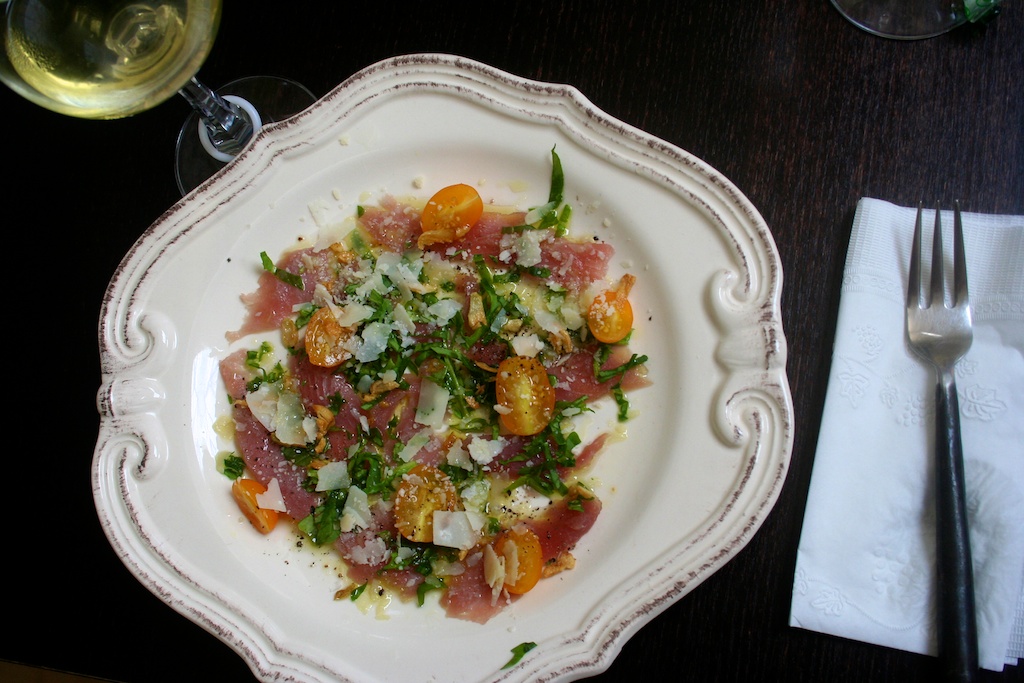
Crudo comes in as many variations as there are Italian restaurants. A dish of crudo rests on three pillars — sashimi-grade fish, a tangy dressing of either lemon juice or balsamic vinegar, and the best olive oil you’ve got. Then you add various “decorations” like minced arugula, shaved parmesan, etc. As you can see from the above photo, it’s also a knock-out to serve to a date or at a small dinner party, as its beauty knows no limits.

I’ve found the best fish to use to be albacore, ahi tuna, halibut or scallops. Yellowtail works nicely too. However, it would be a nice way to serve raw oysters or clams. Or substitute shaved raw beef for a lovely carpaccio.

The following recipe tells you how to make exactly what’s in the picture above. You can do your own riffs — I sometimes add thin slices of grapefruit, dollops of pureed fava bean, whatever is good and in season and that complements the sweetness of the fish, sourness of the citrus (or vinegar) and silkiness of the olive oil. For an artistic flourish, add a drizzle of ebony kecap manis — your friends will forgive you its Indonesian origins for its indescribable sweet, anise goodness. (And when they ask what that sweet black stuff is, just shrug and say, “Dunno.”)

Albacore Crudo

To serve 4-6:

1/2 lb albacore, sashimi-grade
12-15 ripe cherry tomatoes, cut in half
extra virgin olive oil
meyer lemon
1/4 cup arugula, cut into chiffonade (little, long strips)
1/4 cup shaved parmasan
3 garlic cloves, thinly sliced
Maldon sea salt
freshly ground pepper

Place the sliced garlic in a little pan with enough olive oil just to cover. Head over medium until garlic begins to sizzle, and turn to low. Cook, stirring occasionally, until garlic is crisp and golden. Remove and drain on paper towel.

Arrange your serving plates. (Note: for a “communal” crudo experience, you can use one large platter, and guests can all spoon bites from the platter. This is a very dramatic and beautiful way to serve it if you have a large, beautiful platter.) Make sure albacore is very cold (it helps to put it in the freezer for 20 minutes before you begin). Slice it thinly, and arrange slices in random patterns evenly over your plates. Place cherry tomato halves artfully around the fish. Sprinkle arugula chiffonade over each plate. Squeeze a little lemon over each, then drizzle with a generous drizzle of olive oil. Sprinkle shaved parmesan over each plate, then a little Maldon salt (or kosher salt, if you ain’t got Maldon). Lastly, top with a twist of black pepper, and then sprinkle a little crispy garlic over each crudo.

Wine suggestion: a crisp pinot grigio or sauvignon blanc

Next Newer Entries