Teach Your Children Well

This is a post for parents. And for those who are childlike at heart. Because it is in approaching food with a childlike joy and wonder that your cooking will be transformed. And your eating.

Of course, any parent will tell you that children don’t always approach food with a childlike joy. When my son, Flynn, was young. I used to make him baby risottos. They were so good and he loved them so much that we thought of starting a baby food company. But then something happened. He switched. He was suspicious of everything I made. “Dad, there’s a dot in my food!” he would squeal in terror, and the simplest dishes would be derailed by a speck of pepper or a stray trace of parsley.

I was crestfallen.

A chef. And my first-born son would eat nothing but chicken nuggets.

The question, of course, was how to ever get him eating interesting food again. The answer was simple, if not exactly quick. Introduce him to the joy of growing, shopping, cooking and eating. And get him involved. Are your kids involved? Are YOU involved??

I expanded the garden, and gave Flynn his own tomato and corn plants. I got chickens, and put him in charge of egg collection (he now has an egg business selling them in the neighborhood — need any really GOOD eggs? Call Flynn…) My sister got him his own cookbook for his birthday — what a gift! Sometimes I find him sitting on the couch on a Saturday afternoon reading his cookbook. Sometimes he and I watch the cooking shows on PBS on Saturday afternoon. Sometimes we make what we’ve seen.

And I began to request his help in the kitchen. I would let him chop things — supervised, of course — with my really cool, sharp chef’s knife. (Chef’s knives are enticingly exciting to kids, especially boys.) I let him stir sauces. I let him toss the pizza dough in the air. And anytime he wanted a bite of something, I gave it to him.

While he’s still not eating EVERYTHING, there are few things he won’t try. And he’s had the experience enough times of enjoying something wonderful he didn’t want to try, that he believes me when I say, “No, seriously… you’re gonna LOVE this!” Plus, he learned to love the experience of sourcing our food. We go on food adventures. To Little Tokyo to get imagawayaki hot off the grill. To the cheese shop in Beverly Hills. To East L.A. to get handmade tortillas.

Flynn wants to go to France to try the stinky cheeses there. I heard him telling a friend in his taekwondo class the other day about the shabu shabu we were having for dinner that evening. “No,” he explained, his hands gesticulating animatedly, “you cook it right on the table!”

Have you made food an adventure for your children? First, of course, you must make it an adventure for yourself. I guess that’s really what this blog is all about. We’re all kids at heart. Life should always be approached with bright-eyed wonder, as an adventure. And in life, food is one of the greatest adventures of all.

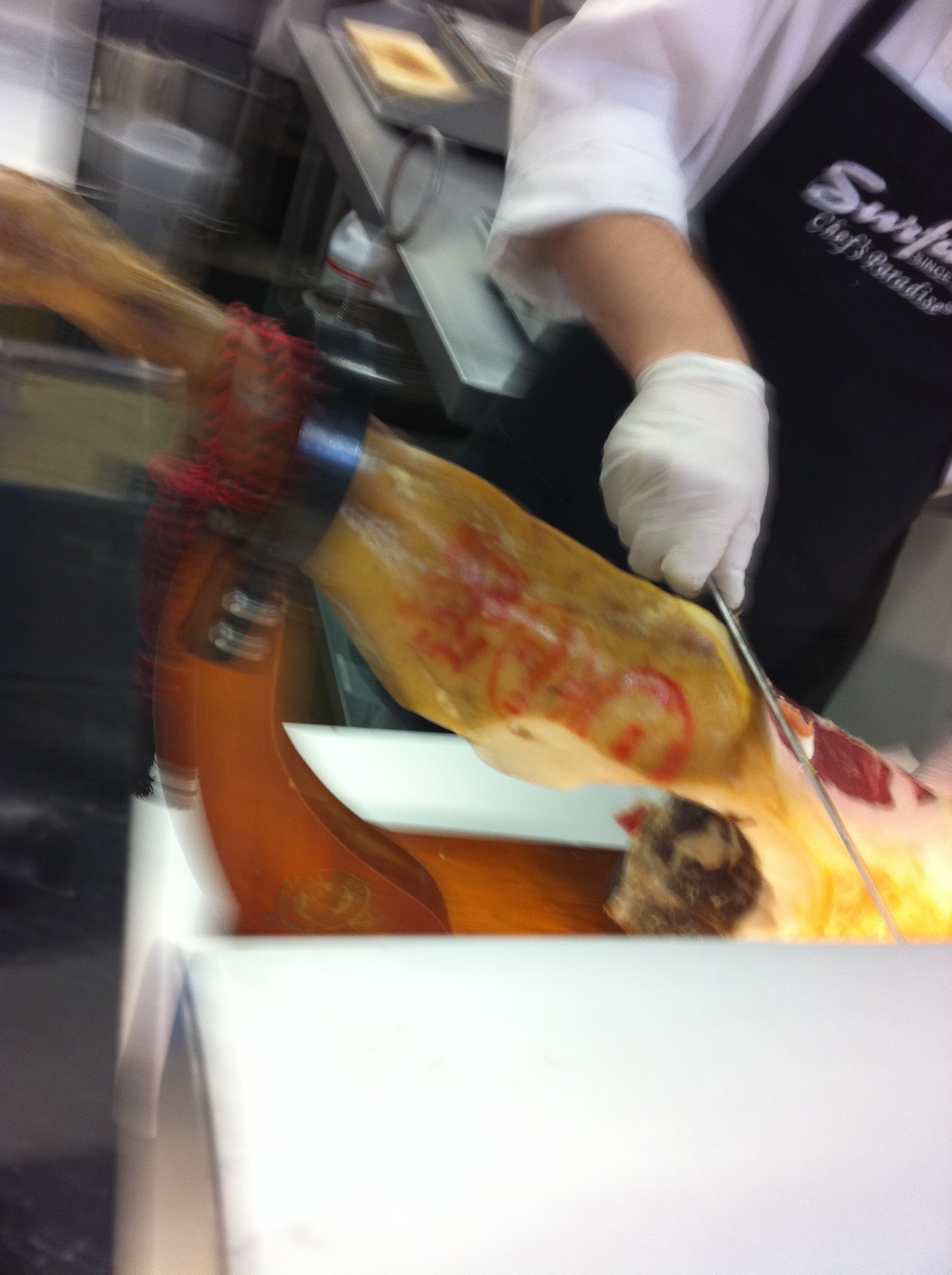
The Most Expensive Ham in the World

jamón iberico bellota

I’d been reading about the stuff for years. A mythical ham cured for years from the meat of the black-hooved Iberian pig, left alone to wander among the oak woods of Salamanca foraging for acorns — “bellotas” in Spanish.

If you’ve ever been to Spain, you know they’re serious about their ham. One of the most popular restaurants in Madrid is the Museo de Jamón — the “Ham Museum”. And in a country that takes its ham this seriously, iberico bellota is king. For years if you wanted some, you would have to travel to Spain. Only recently was it cleared for export to the United States, with our stringent regulations against the importing of long-fermented, unpasteurized things.

Guy carving iberico bellota

Iberico bellota is one of the best things I’ve ever put in my mouth. It will make you forget that proscuitto de Parma you used to think was so good. I love to watch the guy carving slices from the whole ham in the traditional manner (it is never sliced on a machine like proscuitto, so it always has a rustic, thicker quality). The meat explodes on your tongue in layers of flavor — nutty and dense, elegant and briny — and the fat is unctuous and silky. I must stop talking about it now or I’m going to have to excuse myself…

It is, indeed, the most expensive ham in the world — I pay $135 a pound for it, and am grateful for the privilege. I don’t buy it often, and usually get a quarter pound for $35. It’s plenty. You might have trouble finding this stuff. If I were you, I would make like a detective and do whatever you had to do to pick up its trail. If you live in L.A., I get mine at Surfa’s in Culver City. You could likely get it at the Spanish Table in Seattle (I know there’s a few of you out there). Probably Dean & DeLuca’s or someplace like that in NYC. You could buy a whole one online from tienda.com for $1,400. (Let me know… I might go in on it with you.)

A recipe?

Buy some iberico bellota. And eat it. Serves 1. (You won’t want to share.)

If you have to do something to it, get the best crusty loaf of bread you can buy, get the best butter you can buy… tear off a piece, spread a little butter, top with iberico bellota, and sprinkle with a little Maldon salt.

In heaven, iberico bellota will grow on trees like figs.

Wining & Dining 101

“I will drink no wine before it’s time.” —Orson Welles

Well, that didn’t exactly end well, did it…

BTW, Skinny Girls & Mayonnaise can now be followed on Twitter at skinnygirlsmayo — cooking tips, humorous asides, farmer’s market reports, fab ingredients, various little surprises, stealth restaurant reviews… and absolutely no taco trucks whatsoever.

Here’s a fun little quiz before we begin. Answer correctly, and you’ll make me feel better about my own drinking habits.  : )

In Europe, it’s normal to drink with lunch. In America, unless there’s football on, people look at you funny if you drink during the day. Of course, eating a 1,200 calorie hamburger is somehow better…

The object is not to get drunk. It is to enjoy a finely crafted, fermented beverage. Budweiser and Sutter Home wines do not count.

Since well before Christ performed his most famous party trick and turned water into wine, men have been fermenting liquids and enjoying the frivolity that ensued. But drinking wine, beer or other libations with food can be serious business.

Having a family wine business, I’m often asked what wines and drinks go well with what foods. I answer that zinfandel goes well with everything. (That’s the only wine we make!) It’s really a matter of taste. But you do want to choose to drink something that complements your food, or to flip that — choose food that makes your wine taste better. I once had a gooey, stinky French cheese that made the zinfandel we were drinking unfold like a symphony in our mouths. That’s an experience you want.

I try to remember to include wine suggestions with most of my recipes. But here’s some very basic thoughts on food/wine/beverage pairings:

Cheese:
I almost hate to give recommendations with cheese, because this is one of the funnest areas to experiment and find your own favorite pairings. Stronger cheeses like cambembert or La Tur will bring out the characteristics of large, bold red wines. More subtle cheeses — aged parmesan, asagio, brie, gruyere — often pair nicely with white wines. Try farmstead cheeses from England, Ireland, California or Vermont with a malty beer. My mom swears that coffee and cheddar is one of the world’s greatest combinations. Never tried it myself…

Tomato/Meat pastas:
Medium bodied red wines (zinfandel, sangiovese, syrah). Possibly chardonnay.

Lighter pastas:
A refreshing white such as viogner or pinot grigio, or a light red — gamay or a pinot noir. A light lager beer would work well, too.

Fish:
Depends somewhat on sauce, but you’ll usually be okay with a dry white like sauvignon blanc or a French chardonnay. The exception is if it’s an Asian-style fish with a citrus or vinegar sauce. Then you’ll want something sweet like a good saké or a reisling/gewurtraminer. With fried fish, I would recommend a hoppy beer such as Anchor Steam.

Poultry
Depends on the poultry and the preparation. But in general, with chicken or duck, you want a lighter red, white or rosé. If you’re a fois gras eater, one of the world’s great pairings is fois gras with a sweet sauternes from France — the sweetness beautifully cuts the fatty richness of the liver. Lager beers and Trappist-style ales go well with chicken, especially if its fried.

Pork
Ah, pork… be still my beating heart. There may be nothing better than a warm summer evening, a sweet, smoky rack of ribs cooked on the grill, and a big blackberry-filled zinfandel. In general, pork will benefit from medium-bodied reds, such as pinot noir, Spanish tempranillo or sangiovese. A good sauvignon blanc will work well with lighter dishes, such as proscuitto and melon. Crisp, slightly sweet whites like a Central Coast viognier would do well with barbecue or pork chops. And for a BLT, drink Sierra Nevada Pale Ale.

Steak/Hamburgers:
Go for size and flavor here. Obviously cabernet sauvignon or petite syrah. Also good is a big, fruity zinfandel — especially with burgers. Big Italian barolos would pair nicely with steak, too.

Salads:
This is one of the trickier pairings, especially when you’ve got a lot of acidity in the dressing. Softer, less acidic whites tend to do well — a buttery chardonnay, a reisling or a French Pouilly-Fumé.

Chocolate/dessert:
Chocolate and port is one of the world’s great pairings. In general, you’ll want a sweet wine with your dessert. There are many good late-harvest wines being made domestically which bring a lovely finish to your meal.

If you have specific pairing questions, leave a comment with your question and I’ll do my best to answer it.

Church of the Sacred Table

Preparing a meal is a part of my spiritual practice — kinda like meditation or prayer. I’ve never gotten much sitting in a church, listening to that guy on the pulpit talk. I would slouch in the back, as if it was math class, afraid he was going to he call on me, while he rambled on about sin and salvation.

Sitting in a hard, cold pew on a brilliant Sunday morning was not my idea of inspiration — I never caught a glimpse of God in there. But put me in a kitchen beside vegetables yanked from the earth and a briny fish fresh pulled from the sea, and I’ll get lost in an ecstatic reverie that can only be described as mystical.

What is it about this most basic of activities that is so deeply resonant on so many levels? For one thing, it’s useful. I’ve always admired guys who make chairs — there is nothing more important than a chair, especially one that is well made and comfortable. A meal should be the same — well made and comfortable. And yet, it can also be much more. Like a symphony or a work of art or a great achievement in architecture, it can inspire and make us feel our place in the flow of life more deeply. It can connect us to the world — both what’s right there around us, and what’s far away and exotic. And it is an egalitarian pleasure. A rustic bread baked in a tandoori in a grimy alley in New Delhi is every bit as noble as a duck torte from the Parisian kitchen of Ducasse. A $.50 fish taco from a street corner in Puerto Vallarta can linger in the memory just as long as a whole fried catfish from a seafood palace in Hong Kong.

A plate of homemade food is also the antidote to our fast-food culture. I remember feeling encouraged years ago when the Slow Food movement emerged. Preparing a meal from scratch, even if it’s a simple pasta that only takes 20 minutes, is the opposite of that 20-something guy in the Carl’s Jr. commercial grunting and spilling ketchup all over himself. It’s an act of love and respect, toward yourself and the bounty that has been afforded us. Go to the farmer’s market, buy whatever’s in season — not shipped/trucked in from Chile or New Zealand, but from the guy who grew them a few miles away. Listen to what he has to say about sin and salvation. Clear your afternoon and invite some friends over. Invite the farmer. Invite that guy from the pulpit, if you’d like. Open a bottle of wine. Enjoy every moment of slicing the food, watching it transform in the pan, composing the plate as if you were painting your masterpiece. Revel in watching your friends enjoy what you’ve made. Cooking for only yourself? Leave the Souffer’s or Lean Cuisine to freezer burn and get out a pot and pan. Make yourself a three course dinner — after all, who deserves your love and respect more than yourself?

And then take it to the next level, and try growing some vegetables, keep some chickens and collect eggs if you’ve got room, buy a goat and try making cheese. Get your hands into the earth and see how your food grows. Pick a corn right off the stalk and eat it there, the life still pulsing through it.

I once heard the Vietnamese Buddhist monk, Thich Naht Hahn, tell a long story about sitting on a beach in France peeling an orange. Touching the peel, experiencing the scent, biting into the flesh. “An orange, dear friends,” he said, “is nothing less than a miracle.”

As I write this, I am reminded of what’s so important about cooking to me, which is that it reminds me what life is all about. Passion, love, laughter, sharing, family and friends, kindness, generosity, being absolutely in the moment. All the ingredients of a meal shared together. All the ingredients of a life well lived.

Things You Would Never Consider Putting In Your Mouth (and Why You Should) Pt. I

Your ancestors put some pretty gnarly things in their mouths. People in different places at different times have eaten what they had to in order to stay alive. People in some places eat sea cucumbers.

You’ve probably put some pretty gnarly things in your own mouth when you think about it. The same people who wince at the idea of eating an oyster will happily shove the leg of a chicken in their mouth; those who gag at the thought of eating a fried grasshopper will eagerly gobble down a fried shrimp, which is basically the grasshopper of the sea. I guess it’s all about what you’re used to.

I’m going to do a series about things you would likely not consider putting in your mouth, and tell you why you should. I’m not going to suggest anything dangerous or overly slimy. This is not an extreme-eating blog. (Once many years ago, when I first got into hunting wild fungi, I found a particular mushroom with a coating of slime on it. It was large and meaty, though, and I wondered if it was edible. I consulted my books, and found out it was — although the description in one book said, “Edible, though hardly incredible.” The mushroom is called the Hideous Gomphideous. As I was preparing it in the kitchen of my mother’s home in Sonoma, California, mom came by and asked me what kind of mushroom it was. I told her, and she said, “I am NOT eating anything called a Hideous Gomphideous.)

Today I want to tell you about bottarga. A specialty of southern Italy, bottarga is the dried, salted roe sacks of either mullet — bottarga di muggine — or tuna — bottarga di tonna. I decided to write about it this morning, as I was in the kitchen with a very sharp knife shaving the the mold off the outside to have some for lunch when our nanny, Karina, said, “What’s THAT?!?” And I explained to her what it was and what you do with it.

bottarga di muggine

As you can see from the picture, it’s appeal is not immediately clear. Somewhat like an unsliced salami — a good analogy for this particular piece, which has molded over. But the mold merely keeps the treasure inside safe. Like most dried, salted things, bottarga originally evolved in the days before refrigeration as a method to preserve the edible egg sacks of these fish for future use. (It seems to me that many of the world’s best foods evolved in the days before refrigeration.) For eons it toiled in the obscurity of rustic regionality, before finding its way onto the menus of upscale Italian eateries from New York to Beverly Hills. I wish I had known it in the olden days, when it was probably pennies a pound. Now it is an expensive delicacy. But a little goes a long way.

Now what on earth, you reasonably ask, does one do with dried mullet roe? Here’s a lusty summer recipe that will transport you to a seaside village on Sardinia as the sun sets. Make sure you’ve got a big red wine to drink with it. And if you can’t find bottarga or don’t have the will to try it, the recipe will still work with parmesan sprinkled instead.

Spaghetti with Bottarga and Tomatoes

1/2 lb pasta (for two people)
2 large, super-ripe tomatoes, roughly chopped
1/4 cup olive oil plus more for drizzling
dried pepperoncini (crushed red pepper)
1 small, thumb-sized chunk of bottarga
salt & pepper

In a large saucepan, cook the tomatoes in the olive oil until most of the moisture is gone and the tomatoes are thick and saucy. Season liberally with salt. Cook the pasta in salted water until al dente. With tongs, lift the pasta out of the water and into the sauce pan, allowing some of the pasta water to come along for the ride. Turn the sauce to high heat, toss pasta until completely coated. If the sauce has become at all watery, continue to cook over high heat. Then turn off when thickened.

With the tongs, divide the pasta into piles on two large plates. Scoop any extra sauce over the pasta. Sprinkle with pepperoncini, then with a cheese grater, shave the bottarga evenly over the two plates. Serve with salt and pepper to each diner’s preference, and a bottle of good red wine.

Previous Older Entries Next Newer Entries