This is all I got, folks. My greatest sandwich. And I give it to you. I give and I give and I give…
But to get there we must first take a side trip on a long country road. Midwesterners and Southerners may boast of having the best barbecue. But we in California have our own claim to grilling fame. I’m talking about Santa Maria-style, and in particular the tri-tip. We’re not tiptoeing our way around a dainty rack of candied baby back ribs, people. The tri-tip is a wonderful cut that gives you rare and well-done in the same piece of meat. (If you don’t have anyone who wants well-done, you can save the tip and chop it up for tacos the next day!) Akin to Texas barbecue, this is meat at its most elemental. A beefy tri-tip, our own fragrant coastal oak and fire.
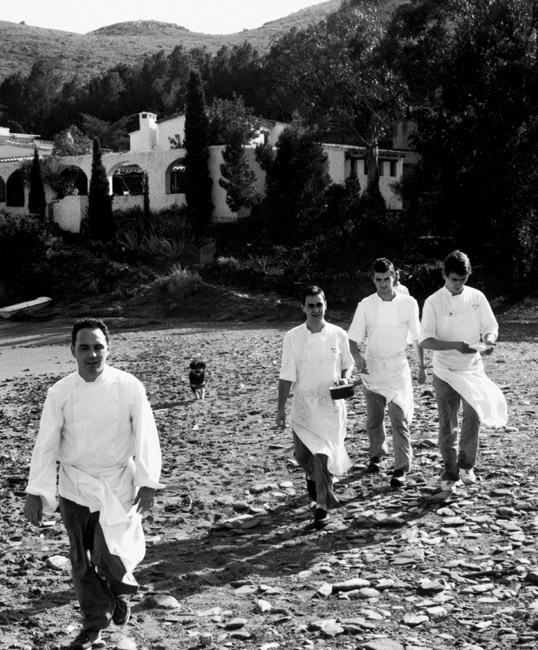
I once exchanged emails with el Bulli. If you’re one of the increasingly few people on Earth who have not heard of el Bulli, it’s a restaurant on an isolated bay called Cala Montjoi on Spain’s Costa Brava, a couple hours north of Barcelona. And even if you’ve not heard of it, you’ve been eating its influence whether you recognized it or not for years. More
Clockwise from top: Blewits, matsutakes, white chanterelles, porcini
Every year, somewhere around the holidays, we load up the car with kids and kid paraphernalia and head north. Our destination? Over the river and through the woods to grandmother’s house — my mom’s place — in the forest of western Sonoma County. We get settled, my kids go for the cookies, and then Dad disappears. Into the wet woods, eyes scanning the shadowy duff for signs of life. Fungal life.
I first got interested in foraging for mushrooms two decades ago, while up at my aunt and uncle’s place in Mendocino. It took five years of identification before I became comfortable eating a mushroom, another five before anyone in my family would trust me enough to eat one. Now, 20 years out, I’m something of an expert. In that time, I’ve only gotten sick once. And that from an edible variety. I’ve never eaten a poisonous mushroom. I find mushrooms people pay top dollar for at fancy food boutiques and farmers markets — matsutake, oyster, porcini, black trumpets… And soon, after the torrential rains we’ve been having in L.A., I’ll see chanterelles the size of baseball gloves popping up in the usually dry woods around my own house.
My kids seem to like my hobby. It combines getting dirty and exploring, two of the best kid things:
Do I advise you take up this pastime? No. And if you must, come out with me and I’ll share my knowledge. I’ve had two people send me emails in the past week with photos of the “chanterelles” they’d found, eagerly waiting confirmation to eat their bounty. My reply in both cases was the same. “Those are NOT chanterelles.”
Once initiated, you may find yourself obsessed. For some, like my wife, it is the thrill of the hunt. She compares it to going to garage sales looking for that one great find. For others, it is the awesome diversity of edible wild mushrooms — some that have the texture and taste of fried chicken, others that smell of maple syrup; some that can substitute for lobster in a bisque, and still others that resemble the mane of a lion. I like the hunt, and I like the cooking. And when it’s dry at home and I can’t get north, I suck it up and buy them from my friends at the farmers market who do the work for me. (Sources for wild mushrooms below)
If you like regular mushrooms, you’ll love wild mushrooms. Even cultivated varieties such as shitake, oyster or shimeji offer an adventure from the ordinary button. But look for some of the varieties I’ve mentioned above, as well as morels, yellow foot, blewits, cauliflower mushrooms and other varieties, at your farmers markets and fancy food boutiques. And when you find them, use them wherever you would regular mushrooms. In a pasta, on a pizza, folded into omelets… If it’s a cold night and you’re wet from the hunt, here’s a nice soup to warm your soul:
Wild Mushroom Bisque
1 lb wild mushrooms (or regular button mushrooms, if you must), sliced thin
2 quarts chicken stock (canned is fine — in fact, water a bouillon cube is fine)
1 onion, chopped
2 tbsp. butter
1/2 cup heavy whipping cream
salt & pepper
Melt the butter over medium heat in a large saucepan. Add the onions and sweat, cooking until they begin to brown slightly. Add mushrooms and turn heat to high. Cook, stirring frequently, until mushrooms release most of their moisture and begin to brown. Add chicken stock, cover and simmer for 20 minutes. Remove from heat and let cool for 30 minutes uncovered.
Transfer soup to a blender. (If there’s too much liquid for your blender, transfer all the solids and half the broth.) Puree on high for a minute, until soup is thoroughly pureed. Return to saucepan, heat over medium until soup begins to simmer. Turn off heat and stir in cream, plus salt and pepper to taste.
Serve with a loaf of crusty bread and some sweet butter, maybe a sweetish white wine like viogner, a fruity zinfandel or a bottle of hoppy beer such as Sierra Nevada or Anchor Steam.
One sparkling winter Sunday morning in Sonoma County, as mist rose from frozen fields through the bare leaves of apple trees, with my wife and kids, my mom and the Wine Guerrilla and miscellaneous sisters, we went to a favorite spot for breakfast. Willow Wood Market Café in the tiny one-horse town of Graton. If you’re ever hungry and meandering along the Gravenstein Highway north of Sebastopol some morning, I suggest you hang a left on Graton Road and do the same.
Unraveling scarves and jackets as we settled around a large table, the comforting scent of sausage and coffee filled the sunlit room. Browsing the menu, my eyes gravitated toward the usual suspects: steak and eggs, smoked salmon, french toast and sausage. And then I spotted an interesting choice: the “market plate breakfast”. Warm polenta, a farm fresh egg, spinach cooked with coppa, roasted tomatoes and camboloza toast. It was a surprisingly harmonious symphony of morning flavors — even the things you wouldn’t expect on a breakfast menu like spinach and blue cheese.
Your kids might screw their noses up at this breakfast, as mine did. That’s just fine… give them Eggos, and save this gem for the grown ups. Did I mention it’s the perfect brunch, particularly when served to friends with a good, spicy Bloody Mary? Cheers.
* * *
Sonoma Market Breakfast
Note: for my version, I like two eggs per and use pancetta instead of coppa
for each breakfast:
2 eggs
1/4 cup dried fine polenta
1/2 cup spinach
1 slice pancetta
5 or 6 heirloom cherry tomatoes
1 slice crusty bread
1 slice (or 1 tbsp crumbled) blue cheese such as cambozola or gorgonzola extra virgin olive oil
salt & pepper
Cook the polenta first: use 2x the water of the dried polenta you are cooking. Heat the water to a boil and add polenta, lowering heat to medium-low. Cook polenta, stirring every few minutes and adding water as it cooks away, for 20 minutes until thick. Cover and set aside.
While the polenta is cooking, roast the tomatoes. Make a little pan out of foil, add the tomatoes and drizzle with olive oil and sprinkle with salt. Cook about 20 minutes at 350 degrees.
For the spinach, cut each slice of pancetta into a few pieces, and saute until rendered and crisp in a tbsp or so of olive oil. Add spinach and cook briefly until wilted. Toast your bread slices and top with a little blue cheese while still hot.
Lastly, cook your eggs. They served poached eggs at Willow Wood, I like to fry them in a pan with a single flip. To compose your Market Breakfast, place some polenta on a plate with the tomatoes and cooking oil drizzled over the polenta. Put the spinach and pancetta next to the polenta, and the eggs next to that. Put a slice of toast on each plate, sprinkle some good sea salt and pepper over the top, and serve.
I was in Alaska once on a luxury cruise ship with some clients of mine and some friends. We went hiking up a mountain from the Disney-esque town of Skagway, and discovered wild porcini mushrooms growing along the path. I picked as many as I could and made a bag out of my shirt, unsure what I was going to do with them all as I was staying in a cruise stateroom with no kitchen.
When we got back into town, we went to the local brewpub for a beer and some crab legs. Sitting at the bar was Celestino Drago, a famous Genovese chef and restaurateur here in Los Angeles, who was the guest chef on our cruise. I approached him looking like an expectant mother, introduced myself, and revealed the contents of my shirt. “Porcini!!” he gaped. “Where did you find them!??” He then presented the answer to my dilemma, inviting me to cook with him one afternoon in the galley of one of the ship’s restaurants.
He trimmed up the porcini and asked me to make a risotto with them. For his part, he found a couple fresh Dungeness crabs from nearby waters, broke them into pieces, and together with tomato and saffron and olive oil, produced one of the best pastas I’ve ever eaten.
I have made it here for you. And included the recipe for Drago’s linguini with crab, as I remember it. Drago might differ. I hope it will be one of the best pastas YOU’VE ever eaten, regardless of whether you are able to pull crabs from your own nearby waters. (I recommend Dungeness crab cracked in the shell for this pasta. There’s a lovely ritualistic quality to breaking the shells and sucking the meat from within while you eat the pasta. In the video, I’ve made it with Alaskan kind crab removed from the shell, which is good too and easier to eat.)
* * *
Linguini with Crab
serves 4
1 lb linguini
1 large Dungeness crab, cleaned
4 large tomatoes
1/2 tsp saffron threads
1/2 cup extra virgin olive oil, plus extra for drizzling
5 cloves garlic, crushed
salt & pepper
Heat olive oil in a large saucepan over medium heat. Cook garlic until golden. Puree tomatoes in a blender, and add to olive oil and cook, stirring frequently.Meanwhile, break up crab into many small pieces, cracking legs and claws.
Heat water in a large pot for linguini. Add 2 tbsp salt and, when the water boils, add linguini, stirring frequently to prevent sticking. While pasta is cooking, add crab chunks to tomato sauce and toss. Add saffron and stir. When linguini is cooked to al dente, scoop from pot into sauce pan and turn heat on to high. Cook, tossing and stirring, for a couple minutes until linguini is well coated with sauce. Season to taste with salt and pepper. Using tongs, scoop onto four plates, making sure to distribute crab chunks evenly. Drizzle with a little additional olive oil and serve.
Wine recommendation: a California pinot noir or Italian sangiovese



 skinny girls & mayonnaise